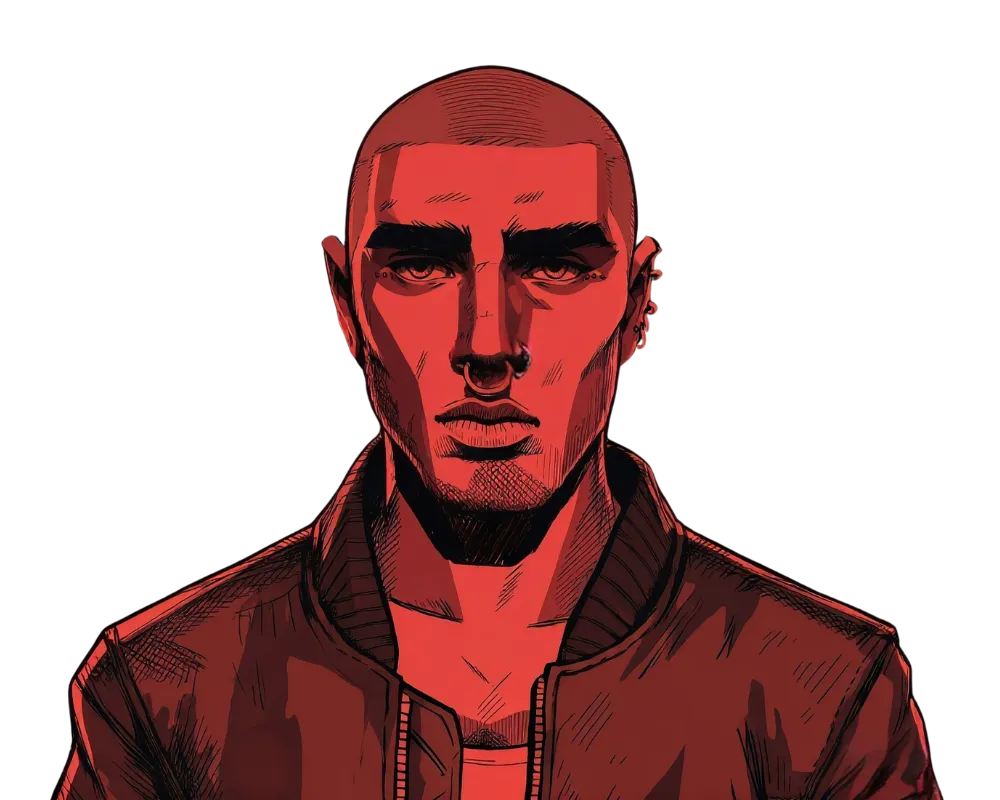
This article draws from online sources. It will be progressively enriched as community voices are shared.
What You Will Understand
- ▸Why gay skinhead identity is fundamentally a paradox — claiming the aesthetic of working-class straightness while being unmistakably queer
- ▸The difference between adopting skinhead aesthetics for sexual appeal versus adopting them as a genuine identity rooted in class and culture
- ▸How gay skinheads navigate the contradiction between hypermasculine presentation and homosexual desire
- ▸Why this particular form of masculinity was radical in the 1970s-80s and what it still means today
The Paradox at the Heart
You put on the boots and something happens immediately. The weight of them. The laces. The specific way they change how you stand, how you move, how you're seen. These aren't neutral clothes. These are the clothes of a working-class man in 1960s East London—a docker, a construction worker, someone doing manual labor. They're the clothes of traditional masculinity, the kind of masculinity that, in most social contexts, has no place for queerness.
That's the paradox. You've chosen the aesthetic language of hyperstraightness. You've claimed the symbols of a culture that, in its original form, had no room for gay men. And in doing so, you've become unmistakably, unapologetically queer.
This is what gay skinhead identity is: a radical misalignment. Not irony exactly—that makes it sound detached, when it's anything but. It's appropriation in the most serious sense. It's taking something that belongs to a world you don't fit into and making it yours anyway, making it mean something else entirely.
Two Approaches to Being a Skin
Research on gay skinheads identifies two distinct orientations, and it's important to understand that these aren't opposites—they're points on a spectrum, and most men move between them.
The first orientation is primarily aesthetic and sexual. You adopt the skinhead look because the skinhead look is hot—the shaved head, the boots, the braces, the cropped hair. The erotic appeal is the entry point. The uniform has been eroticized in gay culture, and you're drawn to it. In this case, you may not identify deeply with skinhead culture or values. You're using the aesthetic, and the aesthetic carries its own erotic charge.
The second orientation is rooted in genuine identification with working-class culture, working-class masculinity, working-class values. For these men, being a skin is an identity claim about where you come from, who you are. The aesthetic is important, but it's secondary to the actual values—loyalty, toughness, a specific relationship to labor and class.
Most gay skins hold both at once. The sexual appeal drew you in. But then you stayed because the identity meant something, because being working-class and masculine felt true, even as being queer complicated it.
Class, Masculinity, and Desire
Here's what matters to understand: gay male culture has historically rejected working-class masculinity. The dominant aesthetic in mainstream gay culture has long been either extreme femininity (queens, drag) or a kind of upper-middle-class ease (bears, gym culture). Working-class toughness? That belonged to straight guys. That was off-limits.
Unless you claimed it anyway.
Gay skinheads, by adopting the aesthetic of working-class manual labor, were making a statement: "This form of masculinity belongs to me too. This is queer now."
Research on gay male sexuality shows that gay men are drawn to masculine features and masculine behavior in partners—this is neurological, not sociological. But mainstream gay culture spent decades telling men not to want that, to move beyond it, to want something more "evolved." Gay skinheads rejected that logic. They said: what if the thing we actually desire is also the thing we're supposed to reject? What if we just... claim it?
The Erotic Charge of the Forbidden
The skinhead aesthetic draws its erotic power partly from its proximity to danger, to aggression, to a form of masculinity that doesn't apologize. In straight working-class culture, this is just... masculinity. It's normal. But in gay culture, where you've been taught that aggressive masculinity is inherently homophobic, taking on that aesthetic becomes transgressive. It carries a charge.
This is where the distinction becomes important: the erotic appeal of skinhead masculinity, for gay men, comes partly from the fact that it's forbidden. Not in the sense that it's actually dangerous or that you're identifying with violence. But in the sense that you're claiming something that's "supposed" to reject you, and that reclamation has an erotic dimension.
You're not confused about your desires. You're not trying to be straight. You're doing something more interesting: you're eroticizing the contradiction itself. You're hot for the boots, the shaved head, the braces—not despite the fact that these things mean "straight working-class guy," but partly because of it. You've made the contradiction itself erotic.
Living the Contradiction
This doesn't resolve into a neat identity. You're not a straight guy with a gay secret. You're not performing straightness ironically. You're living in the space between: genuinely attracted to and identifying with working-class masculinity, genuinely queer, genuinely sexual in ways that are specific to both of those things at once.
Historically, gay skinheads in the 1970s and 80s had to navigate this contradiction in concrete, sometimes dangerous ways. Many came from working-class backgrounds themselves—East London, industrial neighborhoods, places where being gay was not safe, where admitting it could cost you your family, your job, your physical safety. These men found each other in specific venues: the Coleherne pub in London, which became a gay skinhead hangout where you could be both.
That's radical. That's not about aesthetics. That's about survival. That's about finding the people who understood that you could be all of these things at once: working-class, masculine, gay, and unashamed.
What This Means Now
Gay skinhead culture hasn't disappeared. It's evolved. You'll find it in specific spaces—in Berlin's leather and gear bars, in London's underground events, in networks of men who understand that claiming working-class masculinity as a queer identity is still radical, still necessary.
What's changed is that the contradiction is less stigmatized. You don't have to hide as much. But the paradox is still there, and it still matters. The skinhead aesthetic still carries its association with straightness, with class, with physical toughness. And that's exactly why queer men still claim it: because it means something to integrate those things into an openly gay identity.
When you put on the boots now, you're not just wearing gear. You're participating in a specific lineage: the lineage of men who looked at working-class masculinity and refused to accept that it belonged only to straight guys. You're saying, with your whole body: this form of desire is mine. This form of power is mine. This form of masculinity is queer, and I'm living it.
Gay skinhead identity is built on claiming the aesthetic of working-class heterosexual masculinity while being unmistakably and openly queer—this contradiction is the point, not a problem to solve
The erotic appeal of skinhead aesthetics for gay men comes partly from their transgressive quality—they're the symbols of the masculinity you're 'supposed' to desire from a distance, but you're claiming them as your own
There are multiple valid approaches to gay skinhead identity: some emphasize the aesthetic and sexual appeal, others emphasize genuine working-class and cultural identification; most men hold both
Historically, gay skinheads found community in specific venues like the Coleherne, creating spaces where working-class gay men could be visible, authentic, and unashamed
Today, gay skinhead identity remains a statement: that hypermasculinity can be queer, that working-class culture is queer territory, and that integrating these things into an openly gay identity is radical and necessary
What draws you to skinhead identity?
Is it the aesthetic first? The values? The culture? A mix? Tell us what skinhead masculinity means in your life.
Contribute