This article draws from online sources. It will be progressively enriched as community voices are shared.
What You Will Understand
- ▸What rope bondage actually is — and why rope specifically, rather than any other restraint.
- ▸The history: from Japanese hojojutsu and kinbaku to the global shibari community of today.
- ▸The two roles — rigger and bunny — and what each brings to the practice.
- ▸The full spectrum of rope bondage, from purely aesthetic to deeply BDSM — and why all of it counts.
The Rope Goes On
The first wrap settles around the wrist and something in the room changes. The rope has weight. It has texture — the roughness of jute or hemp against skin, which is different from the smoothness of synthetic materials in a way that matters. It has sound: the whisper of it running through a hand, the soft thud of a fall of rope being placed, the particular creak of a knot drawing tight.
And then it is on the body, and the body begins its adjustment. The wrist cannot move in the direction it wants to move. The chest rises and falls against the wrap, feeling the rope shift with each breath. The weight is not heavy but it is present — a continuous physical fact that the nervous system registers and, over the minutes that follow, begins to incorporate into its model of what the body is right now.
This is what rope does that no other restraint quite replicates. Not the restriction alone — handcuffs restrict more efficiently. Not the aesthetics alone — the image of a bound person is available in many forms. What rope does is create a physical relationship between the body and the rope that is ongoing, dynamic, and mutual. The rope is not just on you. You are in it.
Where It Comes From
The lineage of rope bondage runs from hojojutsu — the Japanese martial art of binding prisoners developed by samurai from the 1400s — through the stylized theatrical bondage of kabuki theater and the woodblock prints of the Edo period, into the sexualized practice of kinbaku documented in Japan from the early 1900s.
Seiu Ito, generally recognized as the father of kinbaku, began studying hojojutsu restraint techniques in the early twentieth century and developed from them a practice oriented toward erotic beauty and psychological intensity rather than security. The aesthetic of the exposed, bound body — the specific visual grammar of rope wrapped in deliberate patterns around flesh — became a distinct art form with its own masters, its own vocabulary, and its own dedicated practitioners.
In the West, rope bondage as a developed practice arrived later. The first shibari demonstration in Europe was given in Amsterdam in 1997 by master Akechi Denki. Through the 2000s, the practice spread rapidly as Western practitioners traveled to Japan to learn, as Japanese masters toured internationally, and as online communities accelerated the transmission of technique and culture. Today the global rope community is large, diverse, and technically sophisticated.
Shibari and Kinbaku — What the Words Actually Mean
The two terms are often used interchangeably in Western communities, but they carry different emphases.
Shibari — literally 'to tie' in Japanese — tends to refer to the aesthetic and visual dimension: the patterns of rope on the body, the composition, the artistry of the form. A shibari performance or photograph foregrounds the visual result.
Kinbaku — 'tight binding' — tends to refer to the whole connective practice: the relationship between tyer and tied, the psychological and emotional dimension, the experience as much as the image. Kinbaku is what happens between two people, not just what is produced on a body.
In practice, the most serious Western practitioners use the terms with some awareness of this distinction — shibari for the art, kinbaku for the intimate practice — though the distinction is not rigidly maintained. What it points toward matters: rope bondage is both an aesthetic practice and a relational one, and these two dimensions are not separable.
The Rigger and the Bunny
The person who ties is the rigger. The person who is tied is the bunny.
These are not simply the dominant and the submissive — though a rope scene often does involve a power dynamic, and for many practitioners the power exchange is central. What the terms capture is the specific craft dimension of the practice. A rigger is someone who has developed technical skills: knowledge of anatomy, an understanding of how ropes interact with bodies and nerve pathways, the ability to manage the physical and psychological state of the person in the rope. Rigging is a skill set that requires real development.
A bunny is not merely passive. Being tied well — being receptive in the way that produces the best scene for both people — is its own practice. The bunny who knows their own body, who can communicate subtly through physical feedback, who understands their own headspace and what deepens or interrupts it, is a better partner for a rigger than one who simply submits. Good rope is collaborative in ways that not all kink is.
Both roles have their own experiences, their own pleasures, and their own distinct psychological states. They happen simultaneously, in the same rope, on the same body — but they are different.
The Spectrum
Rope bondage exists across a wider range than most kink practices.
At one end: purely aesthetic tying. The rope on the body as composition, as art, as photography. No power exchange implied, no BDSM context required. Some of the most technically accomplished rope practitioners work in this register — performing at galleries, collaborating with photographers, creating images that are about the beauty of the form.
In the middle: the sensory and meditative dimension. Rope as a practice of presence, of being in the body, of the specific altered state that sustained immobilization and sustained attunement between two people can produce. This does not require explicit BDSM context or explicit sexual content, though it often is erotic.
At the other end: full power exchange. Rope as restraint in service of a BDSM dynamic, with explicit D/s context, punishment, reward, and the specific charge of being genuinely unable to move while someone else has complete access to you.
A practitioner can move across this spectrum within a single scene, and many do. The same rope, the same technique, the same two people — but the register shifts depending on the energy, the intention, and what both people are bringing that day. This flexibility is part of what makes rope bondage one of the most versatile practices in the kink world.
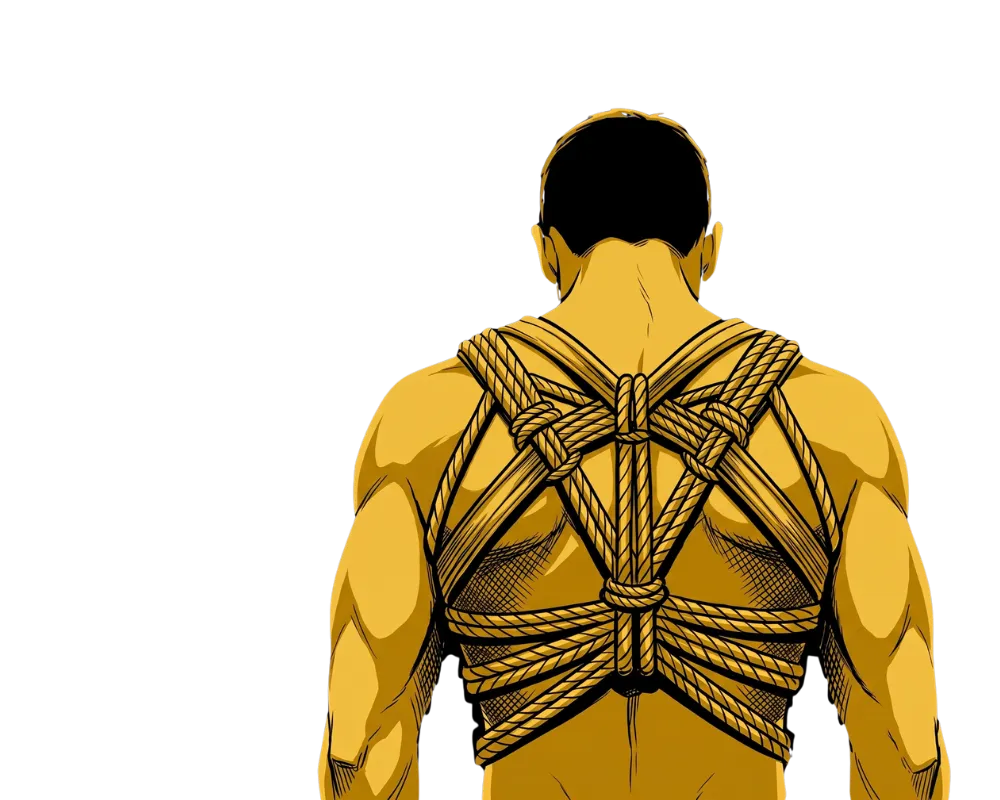
Why Rope Specifically
Every other restraint is efficient. Handcuffs restrict movement precisely and with minimal contact. Leather cuffs are comfortable and quick. Spreader bars are adjustable and reusable. None of them require skill to apply. None of them maintain continuous contact between the person applying them and the person wearing them.
Rope requires the rigger's hands to be on the body for as long as the tying takes. The application is inherently slow, inherently tactile, inherently intimate. The rope that goes around a thigh has been touched by the rigger's hands, threaded through the rigger's grip, felt against the rigger's palm before it settles against skin. By the time a tie is complete, the rigger has been physically present with every part of the body the rope touches.
For the bunny, each wrap lands and then remains — the weight of what has already been done accumulating as the scene progresses. A tie that takes thirty minutes to complete has thirty minutes of progressive immobilization, the body adjusting to each new constraint before the next arrives.
This duration and physical intimacy are what rope produces that no other restraint does. Not restriction but relationship — a slow building of something between two bodies through the medium of rope.
Rope creates a dynamic physical relationship between the body and the material — ongoing, mutual, unlike static restraints.
The practice has specific roots: Japanese hojojutsu, kinbaku, and shibari, entering the Western kink world in the late 1990s.
Shibari and kinbaku carry different emphases: the aesthetic versus the relational. Both dimensions are always present.
The rigger and the bunny both have distinct skills and distinct experiences — the scene is collaborative, not one-directional.
The practice spans from purely aesthetic to deep BDSM, and practitioners move across this spectrum within sessions and across their practice over time.
What Drew You to Rope?
The first time the rope went on — what happened? What keeps you coming back?
Contribute