This article draws from online sources. It will be progressively enriched as community voices are shared.
What You Will Understand
- ▸What the bunny experiences inside the rope — the weight, the surrender, the specific quality of being held.
- ▸What the rigger experiences while tying — the flow state, the attunement, the meditative focus.
- ▸The neuroscience: why rope bondage produces measurable changes in cortisol, endorphins, and psychological state.
- ▸Why rope space is one of the most intimate altered states available in kink — and what makes it different from other headspaces.
Inside the Rope — The Bunny's Experience
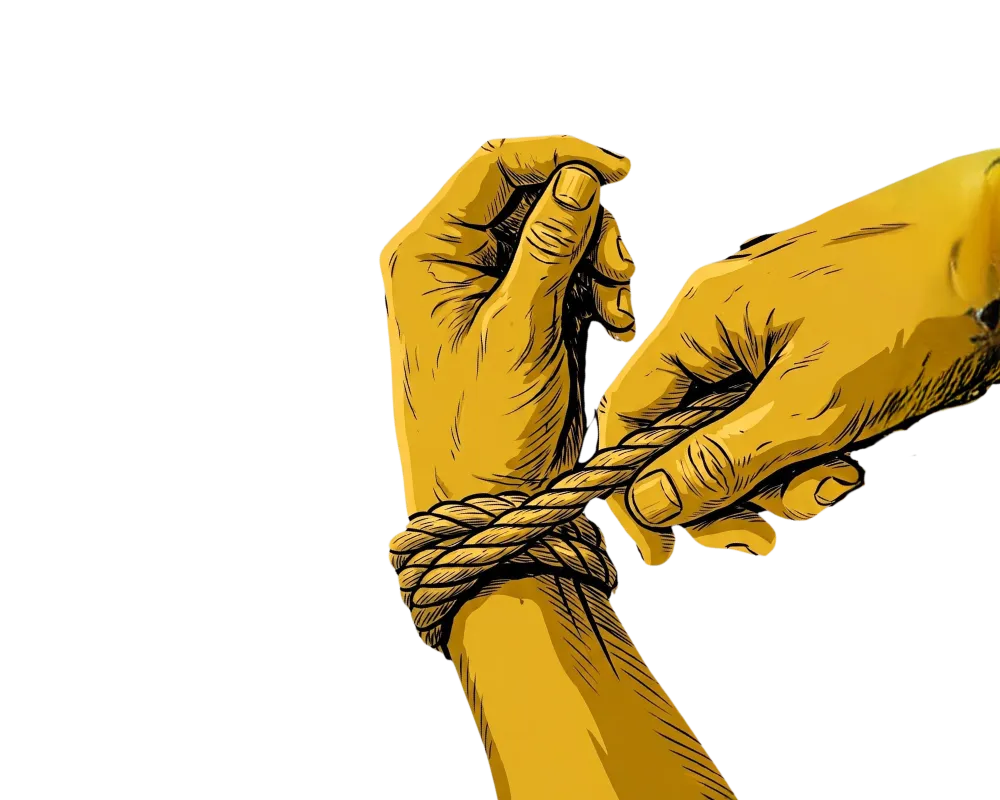
The rope settles and the body registers it. Not just as restriction — as weight, as texture, as presence. Each wrap adds to what came before. By the time a tie is half-complete, the body has already begun its adjustment: this is what I can do, this is what I cannot, this is where the rope is and how it moves when I breathe.
What follows, for bunnies who have found their way into rope space, is a progressive simplification. The range of possible physical action narrows with each wrap, and with the narrowing comes something unexpected: not frustration but relief. The body that is fully in rope does not need to decide what to do with itself. It is held. Its position is managed. What remains is purely sensation — the texture of jute, the weight of the rope running along muscle and bone, the small adjustments the rigger makes that travel through the rope as feeling.
The vulnerability is real. To be genuinely immobilized in another person's hands — unable to move in the ways one would move to protect oneself — is an exposure that produces something in the nervous system that is not fear and is not quite trust but is close to both. The release that comes from settling into that exposure, from letting the body yield to the rope rather than holding against it, is the specific pleasure of the bunny role.
You are not performing surrender. You are surrendering. The rope makes it literal and physical and inescapable. That literalness is what makes it work.
Being Held
There is a quality of being in rope that practitioners describe consistently and that is difficult to convey to people who have not experienced it: the feeling of being held.
Not held as in restrained. Held as in contained — the rope making a form around the body that fits precisely, that distributes pressure evenly across the surfaces it touches, that provides a constant physical reminder of presence from outside. This is related to what researchers studying deep pressure therapy have documented: even pressure applied across significant surface area activates the parasympathetic nervous system, reduces cortisol, and produces a state that the body registers as safety.
The rope bunny in a well-tied bind is receiving that pressure continuously and consistently, plus the specific intimacy of knowing that the pressure was put there deliberately by another person's hands. The combination — the neurological effect of compression plus the relational meaning of being tended to with such precision and attention — produces something that most people experience nowhere else. Many bunnies describe it as feeling more held than in any non-rope context: more present in the body, more contained, more safe.
Inside the Rope — The Rigger's Experience
The rigger's hands are on the rope and the rope is on the body and the rigger's attention is entirely here, on this, on the specific feedback coming through the rope — the tension in the muscle beneath the wrap, the quality of the breath, whether the body is receiving or holding against, whether the next pass needs to go slightly tighter or slightly looser.
This is flow state. Not a metaphor — measurable cognitive flow, the same state documented in athletes, musicians, surgeons during complex operations: total absorption in a complex task that exactly matches skill level, with continuous real-time feedback, without space for self-consciousness or planning. Riggers consistently describe their experience in tying as meditative, focused, present in a way ordinary life rarely is.
The responsibility the rigger carries is simultaneously the source of the challenge and the source of the pleasure. They are managing another person's physical and psychological state through the medium of rope — reading subtle signals, making continuous adjustments, holding the scene's tension and pace and safety in their hands and their attention simultaneously. Getting this right — feeling the bunny settle into the rope as the tie progresses, reading the shift from adjustment to arrival, knowing when to add and when to stop — produces a specific satisfaction that is not available in any other role.
The Neuroscience
A 2016 study published in PLOS ONE (Ambler et al.) measured psychological and physiological states in BDSM practitioners before and after scenes. The findings for rope bondage practitioners: significant cortisol reduction in bunnies, indicating genuine activation of the parasympathetic nervous system. Flow state scores well above baseline in both riggers and bunnies. Mood improvement. Reduced stress markers.
These are not placebo effects or self-report artifacts. They are measurable physiological changes produced by the practice.
The mechanism for the bunny combines several streams. Deep pressure across the body's surface activates the parasympathetic system — the same mechanism behind weighted blankets, compression therapy, and the research on deep touch pressure in autism management. Immobilization activates the endorphin pathway — the body's response to sustained physical constraint includes release of endogenous opioids. The sustained intimacy and attunement with another person activates oxytocin pathways — the bonding hormone that flows during sustained physical closeness and mutual attention.
For the rigger, the flow state is the primary mechanism: total absorption in a complex task with continuous sensory feedback produces the characteristic neurological signature of flow — increased dopamine, suppressed default mode network, the subjective experience of time distortion and effortless competence.
↓ Stress hormones
Cortisol reduction
Ambler et al. (2016): measurable cortisol reduction in bunnies following rope scenes. Parasympathetic activation confirmed.
Rigger and bunny
Flow state
Both roles showed elevated flow state scores post-scene. The rigger's absorption in complex tying and the bunny's immersed surrender both produce the same flow signature.
Oxytocin + endorphins
Deep pressure activation
Continuous rope pressure across the body's surface activates the parasympathetic system and endorphin release — the same mechanism as weighted blanket therapy.
Bonding hormone
Oxytocin
Sustained intimate physical contact and mutual attunement between rigger and bunny activates oxytocin pathways. Rope bondage is among the most oxytocin-rich kink practices.
The Mutual State
What makes rope space unusual — distinctively different from most other kink altered states — is that it is mutual. The bunny's state and the rigger's state are not separate experiences happening in parallel. They are the same experience, entered from two sides of the same rope.
The rigger is reading the bunny's body through the rope — feeling the tension, the breath, the resistance and release — and adjusting their tying in response. The bunny is receiving the rigger's attention through the rope — feeling the quality of the touch, the pace, the deliberateness of each decision — and deepening into surrender in response. Each person's state is being continuously shaped by the other's through the medium of the rope.
This creates an intimacy that is different in kind from other forms of BDSM intimacy. It is not the intimacy of vulnerability to pain or of serving another's will. It is the intimacy of two nervous systems synchronized through sustained physical contact, mutual attention, and shared presence. People who have experienced deep rope space with a good partner consistently describe it as among the most intimate experiences available — not despite the fact that one person is immobilized and one is tying, but because of the specific form that intimacy takes in the rope.
You're not bracing or performing — you're simply being. This can bring up a profound sense of presence and embodiment, because you're no longer doing — you're being held.
— Shibari Studio Berlin
Rope Drop
Rope drop is the emotional low that can follow a significant rope scene — sometimes immediately afterward, sometimes hours or days later.
The neurochemistry of the scene produces elevated states: endorphins, oxytocin, cortisol suppression, flow. The return to baseline as these systems normalize can feel, for some people on some occasions, like a sudden absence — low mood, sadness, disconnection, physical coldness, a quality of loss that does not have an obvious cause.
This is not a sign that something went wrong. It is the predictable consequence of significant neurochemical elevation followed by return to normal. Athletes call it post-competition blues. Musicians call it post-show crash. Rope practitioners call it drop.
Awareness of its possibility is part of what makes a rigger responsible and a bunny informed. Not every scene produces drop. Not every person experiences it. But knowing it can happen — and having support available for it — is part of taking the practice seriously. A rigger who checks in with their bunny the following day is not being overcautious. They are doing one of the important things the role requires.
Rope space for the bunny is progressive simplification — the narrowing of physical possibility produces the relief of being held.
Rope space for the rigger is flow state — total absorption in a complex, responsive task that demands and rewards full attention.
The neuroscience is documented: cortisol reduction, endorphin activation, oxytocin, and flow state are all measurable outcomes of serious rope practice.
The mutual dimension of rope space is distinctive — both people's states are being shaped by each other through the rope, producing a shared altered state that is unusual in kink.
Rope drop is real and manageable — check in the day after a significant scene.
What Does Rope Space Feel Like For You?
Rigger or bunny — describe what it is actually like to be in it. The inside account is the one that matters most.
Contribute