This article draws from online sources. It will be progressively enriched as community voices are shared.
What You Will Understand
- ▸What puppy play actually is — and why calling it role-play undersells it.
- ▸Where it comes from: the specific cultural lineage inside leather and BDSM communities.
- ▸The spectrum of pup identities — from pure play to deep power exchange — and how to read where someone sits on it.
- ▸Why people are drawn to the pup role, and what the pull says about them.
Something Happens on All Fours
Put on the hood. Get on all fours. Stop speaking in sentences.
Something shifts. Not gradually — quite quickly. The architecture of being a person — the social monitoring, the verbal processing, the weight of responsibility and history — starts to loosen. What begins to surface instead is something older and simpler: curiosity, presence, the direct pleasure of physical sensation and movement. The pleasure of being praised. The pleasure of play.
This is not performing a character. The pups who go deep into this practice are not pretending to be dogs. They are accessing a state that is genuinely different from their ordinary waking consciousness — and that difference is the whole point. The hood helps. The collar helps. The physical position on all fours helps. But none of those things cause the state. They give the person inside permission to stop maintaining the human self for a while. The state emerges from that permission.
Where It Comes From
Puppy play has roots in the gay leather community of the 1970s and 1980s. The collar was already there — acceptable, even expected, in leather spaces. Being on all fours was already there, as part of submissive and slave dynamics. What grew specifically out of those contexts over the following decades was something with its own character: lighter than traditional Old Guard slave dynamics, more playful, more focused on the inner experience of the pup rather than on service or punishment.
The internet changed the scale of it dramatically. Through the 1990s and 2000s, pups found each other across distances that would previously have kept them isolated. Communities formed. Gear developed into a dedicated subculture with its own makers, events, and institutions. The International Puppy and Handler Contest launched in 2014. Folsom, IML, CLAW — pups became visible in every major leather and kink event.
Today puppy play sits at an intersection: it draws people from leather, from BDSM, from furry communities, from pet play more broadly, and increasingly from people who have no background in any of those worlds. The community is younger, more gender-diverse, and more geographically distributed than the leather scenes it grew from. What it kept from those roots is the seriousness — the understanding that headspace is real, that gear matters, and that a pup in full space is doing something that deserves to be held well.
What It Actually Is
Puppy play is a practice in which one or more people adopt the mindset, behaviors, and often the appearance of a dog — through gear, physical positioning, and the deliberate loosening of the human social self.
That definition covers a wide range. On one end: two friends in collars and ears playing fetch in a park, no power exchange, no explicit kink content, just the pleasure of being in a playful, preverbal state together. On the other end: a pup in a full latex hood, mitts, tail, and knee pads, fully in headspace, in a structured training session with a handler who commands, corrects, and rewards with the precision of someone who knows exactly what they are doing.
Both of those are puppy play. They are not different versions of the same thing with different intensity levels — they can be genuinely different practices for genuinely different people. Some pups are primarily in this for headspace and community, and sex is incidental or absent. Some are primarily in this for the power exchange, and the headspace is the vehicle. Most sit somewhere between those poles, and where they sit can shift within a single session.
What unifies all of it is the central move: the deliberate, temporary loosening of the human self into something more instinctive, more present, more joyful. The rest varies.
Who a Pup Is
A pup is not a submissive who is wearing ears. The identity is its own thing.
Pups have a specific relationship to the practice that is different from slaves, subs, or bottoms. A sub negotiates, performs, seeks approval as a person. A pup, in headspace, has set much of that down. There is no social negotiation happening. There is curiosity, playfulness, the desire for physical contact and praise, the instinct to run and wrestle and fetch. The orientation toward the handler is different — less formal, more animal, more immediate.
Not all pups are submissive. Alphas — experienced pups who take on a leadership role within a pack or with newer pups — are dominant in orientation. Betas are versatile, comfortable on both sides of a dynamic, sometimes serving as mediators between alphas and omegas. The hierarchy is fluid and matters differently to different packs. What almost all pups share is the headspace itself: the specific state that the practice produces, and the recognition that this state is worth seeking.
Some pups identify as pups full-time. Their pup self is not a scene persona — it is a part of who they are that they carry into ordinary life, in varying degrees. Others are purely scene-based. Both are legitimate expressions of the same thing.
Pup Archetypes
**Alpha** — Experienced, leadership-oriented. Guides newer pups, holds the pack structure, may take on the dominant role in pup-on-pup dynamics. Not the same as a handler — an alpha is still a pup. **Beta** — Versatile, service-oriented, comfortable across the dominance spectrum. Often the connective tissue of a pack. Can lead or follow depending on context. **Omega** — Fully submissive orientation within the pack. Finds pleasure in service and in being guided. Often the pup most fully in headspace during group play. **Feral** — Wild, uncontrolled, resistant to commands. Feral pups are in a deeply instinctive state that prioritizes play, physicality, and sensation over obedience. Playing with a feral pup requires a different skill set from a handler. **Prey** — Engages in chase and capture dynamics. The prey pup wants to run, be hunted, be caught. Usually partnered with a more dominant pup or handler who takes the predator role. **Service Pup** — Combines the pup identity with a service orientation. Available, attentive, useful — but in the way that a good dog is useful, not a human servant.
Why Someone Wants to Be One
Research into why people are drawn to puppy play identifies five distinct motivations — and what is striking is how different they are from each other, and how many people hold several simultaneously.
The most common is not sexual. It is the escape from self — or more precisely, the relief of setting down the ordinary human self with all its monitoring, self-evaluation, and social weight. In pup space, there is no career, no anxiety about how one is perceived, no backlog of responsibilities. There is the room, the handler, the toy, the moment. Researchers describe this state as 'akin to a physically active mindfulness' — intensely present, unreflective, the temporal focus entirely in the now.
Then there is vibrant physicality: the specific pleasure of movement and play that adult bodies rarely get permission for. Wrestling, running, rough-housing, being physically held and restrained — pup play gives access to a register of physical experience that most adults have lost entirely.
Then there is the identity dimension — something the research describes as 'extending and expressing selfhood.' The pup persona can have qualities the human self struggles to access: confidence, directness, playfulness, emotional expressiveness without social consequence. Over time, for many pups, these qualities begin to migrate. The pup self leaks into the human self. They become more confident in ordinary life because they practiced being confident in the hood.
And then there is community — what pups often describe as chosen family. Packs are real social structures, not just scene configurations. The bonds formed in pup space tend to be unusually close, partly because the vulnerability of the state creates intimacy that other social contexts do not.
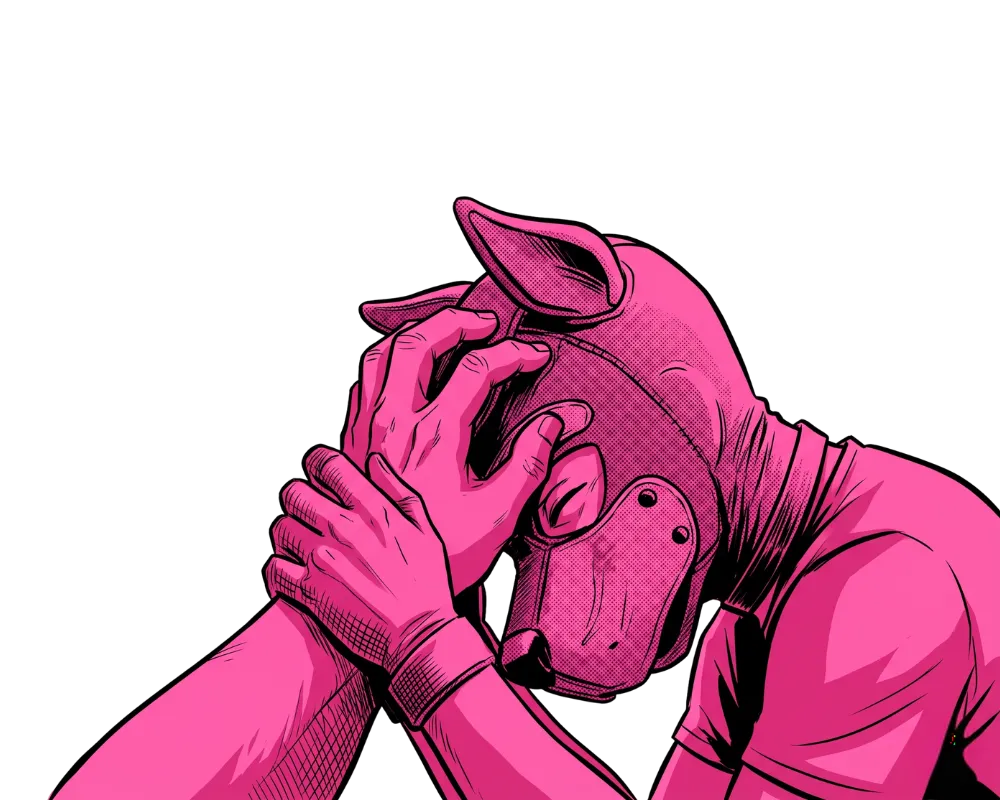
My pup self is leaking into my human self. There are a lot of strengths that my pup self has. It gave me more confidence to take more risks in my day-to-day life.
— Research participant, Archives of Sexual Behavior, 2019
The Gear
Pup gear serves a specific function: it creates the physical conditions that make headspace accessible. For most pups, certain pieces of gear are not optional — they are the mechanism.
The hood is the most significant piece. A neoprene or leather hood that covers the face, gives the head a canine profile, and removes the markers of human identity — expression, hair, features — does something precise: it tells the nervous system that the human self's normal social environment has changed. What follows is a shift that most pups describe as near-immediate with the right hood. The muzzle changes breathing slightly. The ears above change the acoustic register. The visual narrowing of the hood changes peripheral perception. The cumulative effect accelerates the descent into headspace dramatically.
The collar is the other essential piece — less about physical change, more about meaning. Putting on the collar marks the transition. Taking it off marks the return. The collar is the scene's beginning and end, made physical and wearable.
Mitts restrict the hands to paw-like functionality, forcing movement patterns that reinforce the physical identity. Knee pads make sustained floor-level movement possible. A tail — worn as a harness attachment or a plug — completes the visual transformation and adds a physical cue that the body registers with each movement.
None of this gear requires significant investment to start. A collar and a pair of ears can be enough for a first experience of pup space. The gear deepens and refines the practice over time — it does not gate it.
The Pack and the Community
Pup play is unusually social for a kink practice. While many kinks are practiced primarily in pairs or small groups, pup play has developed a robust community infrastructure: pup events, moshes, contests, packs with ongoing relationships, mentorship structures, and a visible presence at every major leather event.
A pack is a group of pups with an ongoing relationship — not just people who scene together but people who maintain the connections between scenes. Packs have their own internal hierarchies, rituals, and identities. They function, as researchers have documented, as 'families of choice' — often providing the kind of unconditional acceptance and physical affection that many people find difficult to access elsewhere.
The mosh is the quintessential pup community event: a space where multiple pups play together, with handlers managing the energy and safety of the group. First-timers enter moshe and discover, often to their surprise, that the group dynamic accelerates pup space dramatically. The contagion of headspace in a room full of pups is real — seeing others drop makes it easier to drop yourself.
Puppy play is not role-play — it accesses a genuine altered state that practitioners recognize and return to deliberately.
It has roots in 1970s-80s gay leather culture and has developed its own gear, events, and community infrastructure.
The practice exists on a wide spectrum, from purely playful and social to deeply sexual and power-exchange focused.
The pull toward pup identity is specific: escape from the social self, access to vibrant physicality, identity extension, and community.
Gear — especially the hood and collar — is the mechanism of the transition, not its decoration.
What Drew You to the Pup World?
Every pup's entry point is different. What was yours — and what did you find once you got there?
Contribute