This article draws from online sources. It will be progressively enriched as community voices are shared.
What You Will Understand
- ▸What pup space actually feels like from the inside — not what it looks like from the outside.
- ▸The psychological and neurological mechanisms that make this state real and measurable.
- ▸How the descent happens, what accelerates it, and what breaks it.
- ▸Why the pup self can change the human self — and why this is one of the most distinctive aspects of the practice.
The Hood Goes On
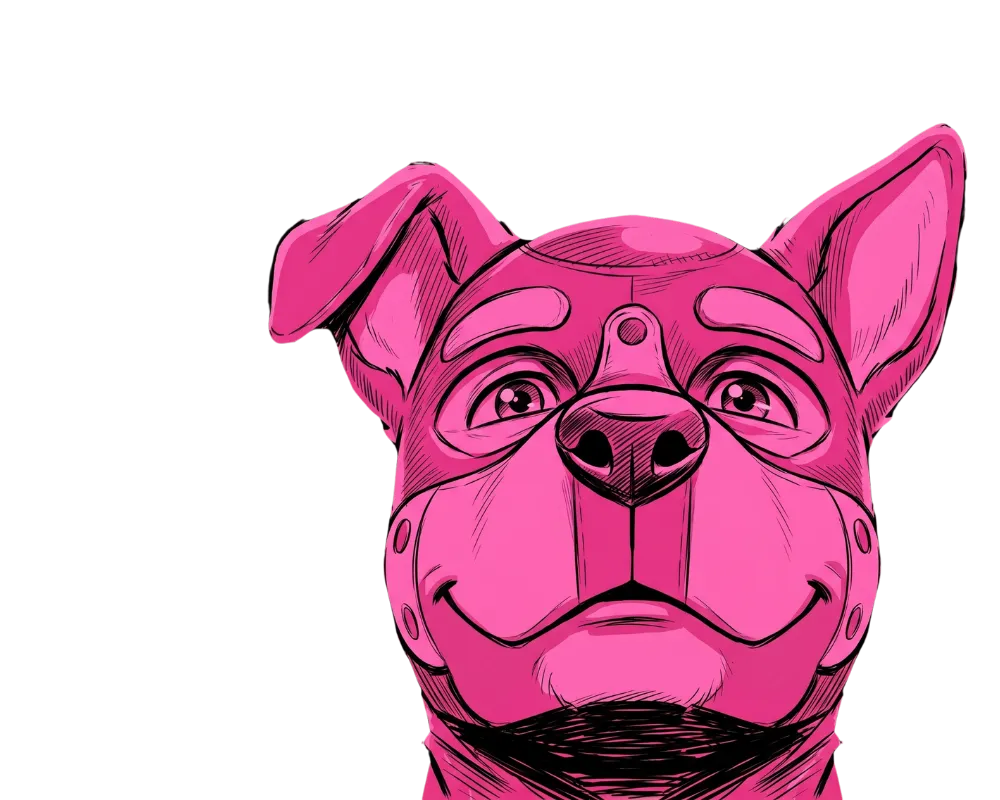
The moment the hood closes over the face, something shifts. Most pups describe it as near-immediate — not a gradual change but a click, a threshold crossed. The face disappears. The muzzle changes the relationship to breathing. The ears above pick up sound differently. The visual field narrows.
With it goes a weight that most people carry so constantly they have stopped noticing it: the weight of being perceived. Of managing how you appear to others. Of being responsible for the continuous social performance of being a person. The hood removes the face that performs that social work. Without it, the nervous system begins, fairly quickly, to stop trying to run the programs that require it.
What surfaces instead is not emptiness. It is something older and more immediate: curiosity about the room, attentiveness to physical sensation, the urge toward movement and play. The desire to be close to the handler. The primal satisfaction of a scratch behind the ear.
This is pup space. Not a persona put on but a state dropped into. Not performance but presence.
What the Research Shows
The academic study of puppy play is newer than the practice itself, but the research that exists is unusually consistent. A 2019 phenomenological investigation published in Archives of Sexual Behavior analyzed the experiences of 68 pups and 25 in-depth interviews. The central finding: puppy headspace is a state of 'minimal reflective self,' described by researchers as 'akin to a physically active mindfulness.'
The parallel to mindfulness is precise. Both states involve a dramatic reduction in what psychologists call default mode network activity — the brain's self-referential processing, the mental machinery that generates the ongoing narrative of 'me' and 'my situation' and 'what I should be doing.' In mindfulness meditation, practitioners learn to quiet this network through sustained attention. In pup space, physical positioning, gear, the presence of a handler, and the permission to be non-verbal all work together to produce the same quieting through somatic and relational means rather than cognitive ones.
Researchers also invoke Baumeister's theory of escape from self — originally developed to explain masochism but applicable broadly to altered states sought in BDSM contexts. The theory holds that people seek states of low self-awareness because ordinary self-awareness carries an enormous cognitive and emotional load: evaluating oneself, anticipating judgment, managing social presentation. Removing that load, temporarily, is not escape but relief — and the relief is the primary therapeutic mechanism of the state.
Reduced self-reference
Default mode quieting
The neural network that generates self-monitoring and social evaluation loses dominance. Same mechanism as advanced meditation, but accessed through somatic and relational cues.
Intensely present
Temporal focus
Worries about past and future strip away. The focus is entirely in the now — what is happening in this body, in this room, with this person.
Load reduction
Escape from self
Baumeister (1988): the ordinary self carries constant evaluative weight. Pup space removes that load through a state of 'minimal reflective self.'
Absorption
Flow state parallel
The physical play and vibrant movement of pup space produces the same deep involvement as flow — loss of self-consciousness through full physical engagement.
The Descent
Getting into pup space is not a switch. It is a transition that takes time and has recognizable stages — and understanding them helps both the pup and the handler navigate the scene.
It begins before the hood. The ritual of getting dressed — putting on the collar, the mitts, the knee pads, the hood — is already a transition. Each piece changes the physical and sensory experience of the body. By the time the hood is fully on, the nervous system has been receiving transition signals for ten or fifteen minutes. The hood finalizes them.
For the first few minutes after the hood goes on, the human self often still runs its usual programs. The pup is aware of the room, aware of being watched, aware of whether they are 'doing it right.' This is normal. It passes. An experienced handler does not rush this stage — they let the pup settle, perhaps moving slowly around the space, perhaps offering a toy, creating the conditions for the drop without demanding it.
Then the chatter runs out. The verbal, evaluative mind finds less and less to work with. Movement becomes easier and more instinctive — not performed crawling but actual crawling, the body finding its own rhythm. The floor becomes interesting. The handler's presence becomes enormously important in a way that is not quite social. This is the entry into pup space proper.
What accelerates the descent: physical play. Wrestling, fetch, rough-housing — the body in vigorous, joyful movement shuts down the reflective self faster than stillness does. This is what sets pup space apart from the gimp or drone headspace: pup space is physically active. The joy and the vitality of the animal state is not incidental — it is part of the mechanism.
What It Feels Like to Be There
Pups who have been in deep headspace describe it in terms that are immediately recognizable to each other and genuinely surprising to people who have not been there.
The verbal self goes offline first. Not completely — pups retain human processing, they retain the ability to use a safeword, they retain basic awareness of the room — but the continuous internal monologue that characterizes ordinary waking life goes quiet. What one participant described as 'a much more preverbal state' is the most consistent description in the research: thought without language, awareness without commentary.
What remains is extraordinarily present. The texture of the floor. The weight of the handler's hand. The smell of the room. The pull of a toy across the floor. Sensation without interpretation, pleasure without analysis.
Puppies in headspace are joyful in a way that is also unusual — the kind of uncomplicated, physical joy that adults rarely access. The research calls it 'vibrant physicality': the body moving freely, play for its own sake, the pleasure of wrestling or running or being held without any of the social calculus that normally overlays physical contact.
And then there is the handler. In pup space, the handler is experienced differently than any other relationship. One participant described it as a 'very primal attitude' — not 'this is my good friend' but 'this is my person, this is the head of my pack, this is who I am devoted to.' The relationship becomes the anchor of the entire experience. Everything that is safe and good is located there.
That is the point where I allow myself to shed the ability to talk — and with the ability to talk, it allows me to enter a much more preverbal state. Something like Zen.
— Research participant, Archives of Sexual Behavior, 2019
The Identity Dimension
One of the most distinctive aspects of puppy play — something that sets it apart from most other kink practices — is what the pup self does to the human self over time.
Many pups describe their pup identity as having qualities that their human identity struggles with: directness, confidence, emotional expressiveness, playfulness, the ability to receive and give affection without overthinking it. These qualities emerge naturally in headspace because the social machinery that normally suppresses them is offline.
What researchers find, and what pups report consistently, is that these qualities migrate. The pup self leaks into the human self. A person who is anxious and self-conscious in daily life discovers, over months of pup play, that some of what they find easy in headspace has become easier outside of it. They are more direct. They ask for what they want. They worry less about being judged.
This is not unique to pup play — the same has been documented in other headspace practices — but it is particularly pronounced here, perhaps because the pup state is so clearly positive, joyful, and alive. The qualities it activates are not edgy or dangerous. They are qualities most people want more of. Taking them back out of the scene and into ordinary life is intuitive.
Coming Back
Coming out of pup space is gentler than coming out of deeper dissociative states, but it is still a transition that benefits from being managed rather than abrupt.
A pup coming up from deep headspace may be slow to speak, physically warm and tired from play, emotionally open and affectionate in ways they would not normally be. The handler's job at this stage is not to debrief or evaluate the scene — it is to stay close, continue physical contact, and let the transition happen at its own pace.
For many pups, the immediate post-space period is one of the most valuable parts of the experience: the warmth and closeness of being held while the human self reassembles itself. Some pups are hungry. Some are sleepy. Some want to talk, eventually, about what they experienced. Some do not.
Pup drop is possible — the emotional low that can follow a very deep or long session, sometimes arriving hours or days later. The pattern is similar to sub drop in other BDSM contexts: a neurochemical return to baseline after elevated states, sometimes experienced as low mood, sadness, or disconnection. Awareness of this possibility, and having support available for it, is part of how experienced practitioners manage the practice over time.
Pup space is a state of minimal reflective self — not emptiness, but presence without the usual cognitive overhead.
The neuroscience is documented: default mode quieting, escape from self, flow state mechanics all apply.
Physical play accelerates the descent. Pup space is active — the joy and movement are part of the mechanism, not decorative.
The handler is experienced as an anchor in pup space — the source of safety, structure, and meaning.
Over time, the pup self leaks into the human self — qualities accessed in headspace become available in ordinary life.
What Does Pup Space Feel Like For You?
Every pup's experience is different. What does it feel like when you drop — and what do you carry back?
Contribute