This article draws from online sources. It will be progressively enriched as community voices are shared.
What You Will Understand
- ▸Why pup gear is not costume — each piece does something specific to the body and the nervous system.
- ▸The hood, the collar, the mitts, the tail: what each one produces and how to choose.
- ▸Why material matters more than aesthetics — neoprene, leather, and latex each create a different experience.
- ▸How to build a kit in the right order without wasting money on the wrong things first.
The Collar Goes On
Before the hood, before the mitts, before anything else — the collar.
For most pups, the collar going on is the signal. Not the beginning of the scene — the beginning of the transition. Something in the nervous system responds to the weight of it, the restriction at the throat, the sound of the buckle or the click of the lock. The body recognizes what is happening. The shift begins.
This is why pup gear is not costume. Costume is worn to look like something. Pup gear is worn to become something — or rather, to create the physical conditions under which that becoming is possible. Every piece in a serious kit serves that function. The aesthetics are real and they matter, but they are downstream of the mechanism.
The Hood: The Central Piece
The hood is where pup space most consistently lives. Most pups who have been doing this for any length of time will tell you the same thing: the moment the hood goes on, something shifts. Not metaphorically — the nervous system receives a set of signals that together say: the rules have changed.
The face disappears. With it goes the social machinery that requires a face: the expression management, the readability, the continuous performance of being a legible person. The ears above change the acoustic register. The muzzle narrows the visual field slightly and changes breathing in ways the body notices. The weight and compression across the skull tell the brain it is contained.
The cumulative effect is a descent toward pup space that, for pups who have worn their hood enough times, is near-automatic. The gear has been conditioned. The nervous system associates the hood with the state. The state becomes more accessible every time the hood goes on.
Not all hoods produce this equally. Choosing the right hood for your practice is one of the most important decisions in building a kit.
| Neoprene | Leather | Latex/Rubber | |
|---|---|---|---|
| Fit | Stretchy, forgiving, soft. Accommodates most head shapes without custom fitting. | Structured, close-fitting. Molds to the face over time. More precise fit required. | Tight, compressive, second-skin. Requires careful sizing and dressing. |
| Weight | Lightest option. Almost disappears once on. | Moderate weight. Presence felt throughout the session. | Medium to heavy depending on thickness. Grounding. |
| Sensation | Soft, warm, breathable. Gentle compression. | Firm, structured, dense. The scent is significant. | Smooth, glossy, warm. Heat builds faster than neoprene or leather. |
| Scent | Subtle. Low conditioning trigger. |
Beyond material, hood configuration shapes the experience in equally significant ways. A hood with eyes open keeps peripheral vision, maintains some environmental awareness, and is better for active play and group dynamics. A hood with closed or restricted vision accelerates the drop — the brain gives up environmental mapping faster without visual input, and pup space deepens more reliably.
Muzzle length changes the relationship to breathing and expression. A longer, more canine muzzle produces a more complete visual transformation and a greater physical sense of having a different face. A shorter muzzle with more jaw mobility is better for longer wear and for sessions that include vocal play.
For a first hood: neoprene, eyes open, standard muzzle. Lightweight, forgiving, good for active play. Build from there once you know what the experience does and what you want more of.
The Collar: Not an Accessory
In most kink contexts, a collar is a symbol. In pup play, it is that — and also a mechanism.
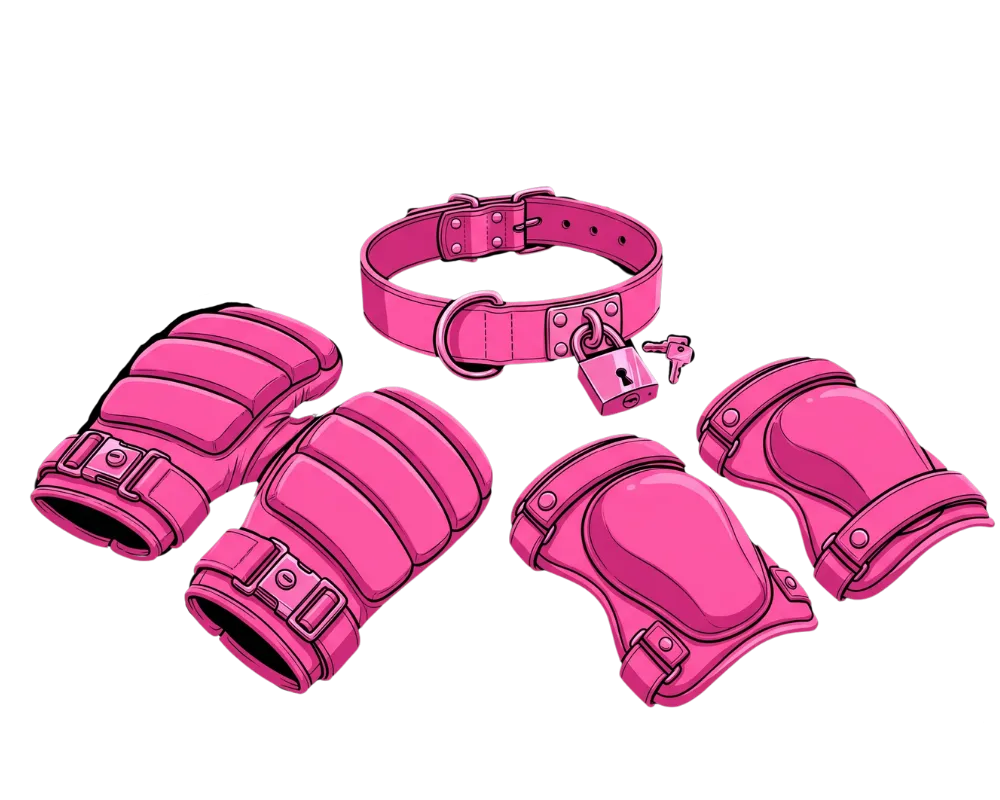
The ritual of the collar going on and coming off bookmarks the scene in a way that is physically felt. The weight of it at the throat. The restriction when the neck turns. For locked collars, the specific knowledge that it cannot be removed without the handler's key. The collar makes the pup's state material — wearable, visible, and subject to another person's management.
Locking collars carry the most psychological weight. The lock is not primarily a security measure — it is a transfer of sovereignty over access to one's own body. The handler holds the key. The pup is locked. This is explicit, physical, and present throughout the session in a way that no verbal agreement replicates.
Many pups who are in ongoing handler relationships wear a day collar in ordinary life — a piece discreet enough to pass as regular jewelry or clothing, but one that the pup knows and the handler knows is the collar. This continuous wearing integrates the pup identity into daily life in a low-key way: a reminder, a grounding, a thread connecting the scene to everything else.
For handlers: the collar is one of the most powerful tools available, and the ritual of putting it on matters. Take your time with it. Make it deliberate. It is the moment the dynamic formally begins.
Mitts: Hands Into Paws
Mitts do something specific and non-obvious: they change how the body moves.
Hands are the primary instruments of human agency — the things we use to make, manipulate, communicate, and act in the world. Mitts close them off. The fingers are enclosed in padded paw-shaped forms that prevent fine motor activity. You cannot open a door, operate a phone, or gesture in ordinary human ways. What you can do is pad across the floor, paw at a toy, and rest your paws on someone's legs.
The movement change this produces is real and relatively rapid. Without functional hands, the body defaults to the floor. Crawling becomes the natural movement mode. The physical experience of navigating a room on all fours — without the option of standing and using your hands as a human — accelerates the pup headspace in a way that is different from the hood but complementary to it.
Mitts are also a strong signal to the handler and to any other pups in the room. A pup in mitts is visibly in a different mode. The gear communicates the state and the state supports the gear — each reinforces the other.
For extended wear, padding matters. Cheap mitts produce hand cramping. Quality mitts have enough interior space for the fingers to rest comfortably without being jammed. Look for mitts with internal wrist support and external surfaces that protect the floor — your wrists will thank you after an hour.
The Tail: Completing the Picture
The tail does two things: it completes the visual transformation, and it creates a physical cue that the body registers continuously throughout the scene.
The physical cue is the less obvious but more interesting one. A tail — whether worn on a harness or inserted — adds weight and movement to the lower back that the body is not accustomed to. Every time the pup moves, the tail moves. The sensation is constant and consistent, a low-level physical reminder of the state that runs under everything else in the scene.
Tails come in two configurations. Harness-attached tails fix to a belt or strap worn around the hips — no internal component, appropriate for all pups including those who do not want any kind of insertion, good for active play and long sessions. Plug tails use an internal component for attachment — the tail is worn internally, which adds another layer of physical awareness and, for the pups who use them, a specific erotic dimension.
Tail length and weight also matter. A short, lightweight tail is barely felt and stays mostly still during movement. A long, heavy tail creates significant movement with every step and is much more physically present throughout the scene. For beginners: start lighter. The physical presence of a large tail during an hour-long crawling session is more than most people anticipate.
Color and style are the pup's own expression — breed-inspired, fantasy-colored, or custom-designed. The tail is one of the most visible personal expression elements of the kit.
Knee Pads: The Practical Essential
Knee pads are not glamorous. They are also non-negotiable for any session that involves sustained crawling or floor-level play.
The floor is hard. After twenty minutes on your knees, you will think about nothing except your knees. After forty minutes you will have difficulty thinking about anything else. Knee pads solve this problem completely — and they solve it in a way that allows the rest of the scene to happen without constant physical interruption.
For active play and moshe events, purpose-built pup knee pads (neoprene-padded, contoured for crawling positions) are worth the investment. For lighter use, skateboarding or volleyball knee pads work well and are far cheaper. The key spec: enough padding to protect the kneecap during directional changes and impact, and a strap system that stays in place through active movement.
Some pups fold knee pads into their aesthetic — matching neoprene to the hood, coordinated colors. Others treat them as purely functional and keep them minimal. Either works. What does not work is deciding they are optional and spending the second half of a session in pain.
Harness
A harness is not strictly required, but it serves functions that no other piece does.
Practically, it provides anchor points — for the leash, for a tail attachment, for restraint if the scene involves it. A handler who wants to guide a pup with a leash needs something to attach it to: the collar works, but a chest harness distributes the pressure more comfortably for extended leash work and gives the handler more precise physical control.
Aesthetically, a harness draws lines across the body that emphasize form and structure. It makes the body visible in a specific way — framed, organized, owned. For pups who are doing display or exhibition work, a well-chosen harness is part of the visual language of the scene.
For pups who want to combine pup play with other kink practices — restraint, bondage, electrostimulation — the harness is the infrastructure that makes those combinations practical.
Building a Kit
The most common mistake is buying everything at once. The result is a collection of pieces chosen without the experience to know what you actually want, sized imprecisely, and assembled in a way that does not produce the experience they were supposed to.
The right order:
**Start with a collar.** Any collar. It can be simple — leather or neoprene, basic buckle or clip. The collar is the ritual object. It costs almost nothing and changes the psychology of the session immediately. Buy one, wear it, understand what it does.
**Add the hood.** This is where real investment makes sense. A quality neoprene hood from a serious maker — eyes open, standard muzzle — is the piece that will do the most work in your kit. It will also be the piece you replace as you understand more precisely what you want. Expect to own several hoods over time, each one more tailored to your specific practice.
**Add knee pads before you need them.** Do not have your first extended session without them. Any sports knee pads work to start. Upgrade to purpose-built pup pads once you know the style that fits your movement.
**Then the mitts.** Once you understand what the hood does to your headspace, the mitts will add another dimension. Quality mitts with good padding — not fashion pieces with no interior structure.
**Then the tail.** The tail personalizes the kit and completes the visual transformation. Choose based on your intended use: harness-attached for active and social play, plug-attached if that is your preference.
**Harness when it becomes relevant.** If you are doing leash work, display scenes, or combination play with other kinks, add the harness. Not before.
Care as Ritual
How you treat your gear after a session says something about how seriously you take the practice.
Neoprene: mild soap and warm water, air dry flat or hung, away from heat. Do not fold damp — mold is invisible until it is a problem. A well-maintained neoprene hood will last years of regular use.
Leather: clean with a damp cloth, condition with a leather-specific product after every few sessions. Leather that is not conditioned dries and cracks — slowly at first, then suddenly. A quality leather hood that is cared for improves with age. It develops a patina, softens in exactly the places it needs to, and carries the history of every session in its texture.
Latex: rinse immediately after use, dry with a soft cloth, apply latex shine or talcum powder before storage. Never store latex folded in contact with itself — it will bond permanently. Never leave it in direct sunlight or heat.
The routine of cleaning and preparing gear after a session is also a transition ritual — the counterpart to suiting up. Taking time with it is not maintenance. It is the quiet end of the scene, the moment where the pup becomes a person again and takes care of the objects that held the other state.
Pup gear is not costume — each piece creates specific physical conditions that make pup space more accessible.
The hood is the most psychologically significant piece. Invest in it first and choose material based on how you intend to use it.
The collar bookmarks the scene — putting it on and taking it off is a ritual that the nervous system learns to respond to.
Mitts change how the body moves by removing hand functionality. The movement change accelerates the headspace shift.
Build the kit in order: collar first, then hood, then knee pads, then mitts, then tail. Each piece adds a dimension when you understand the ones before it.
What Is Your Most Important Piece of Gear?
Every pup has a piece that changed everything. What was yours — and what did it do that nothing else had?
Contribute