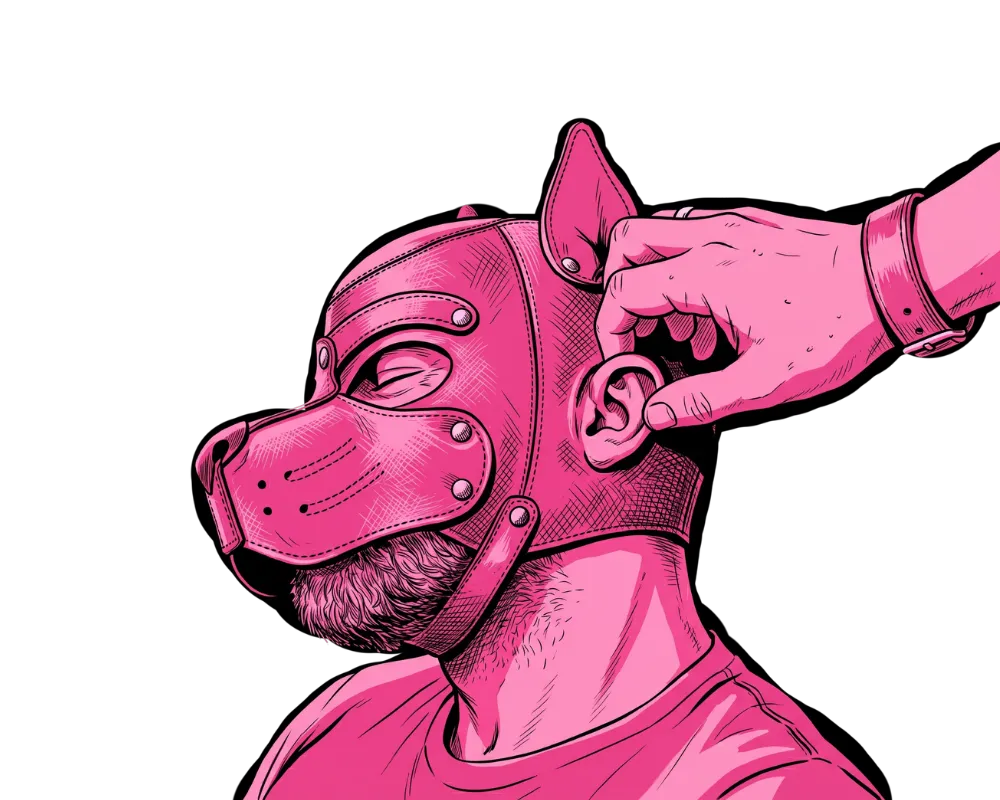
A pup in deep headspace is not going to tell you how they are doing. Verbal self-reporting requires the cognitive machinery that headspace has suspended. What you have instead is the body, which tells you everything you need to know if you have learned to read it.
Energy level is your main signal. A pup with good energy — alert, oriented toward you, responsive to movement and sound, engaged with toys and play — is in a good state. A pup whose energy drops flat — slow to respond, orientation diffuse, movement mechanical — is either exhausted, uncomfortable, or something else. Watch for the transition.
Physical restlessness is different from play energy. A pup who cannot settle, keeps changing position, breaks eye contact repeatedly, is signaling something. It might be a physical issue — a position that is uncomfortable, a piece of gear that is wrong. It might be that the headspace has not fully established. Either way, act on it: adjust the environment, change the activity, check the gear.
The sounds a pup makes are also information. Whines, whimpers, and growls each mean something and the meanings are learnable with experience. A pup who goes very quiet when they are normally vocal may be dropping deep — or may be distressed. The difference is visible in the rest of the body: in deep space, the quiet is accompanied by relaxed muscles and settled movement; in distress, the quiet comes with tension.
The pre-arranged signal matters here as much as it does in any deep-state dynamic. Establish it before the session. Something simple and physically executable even in full mitts and headspace: a specific paw tap, an object to push, a sound that means stop. Trust it when it comes.