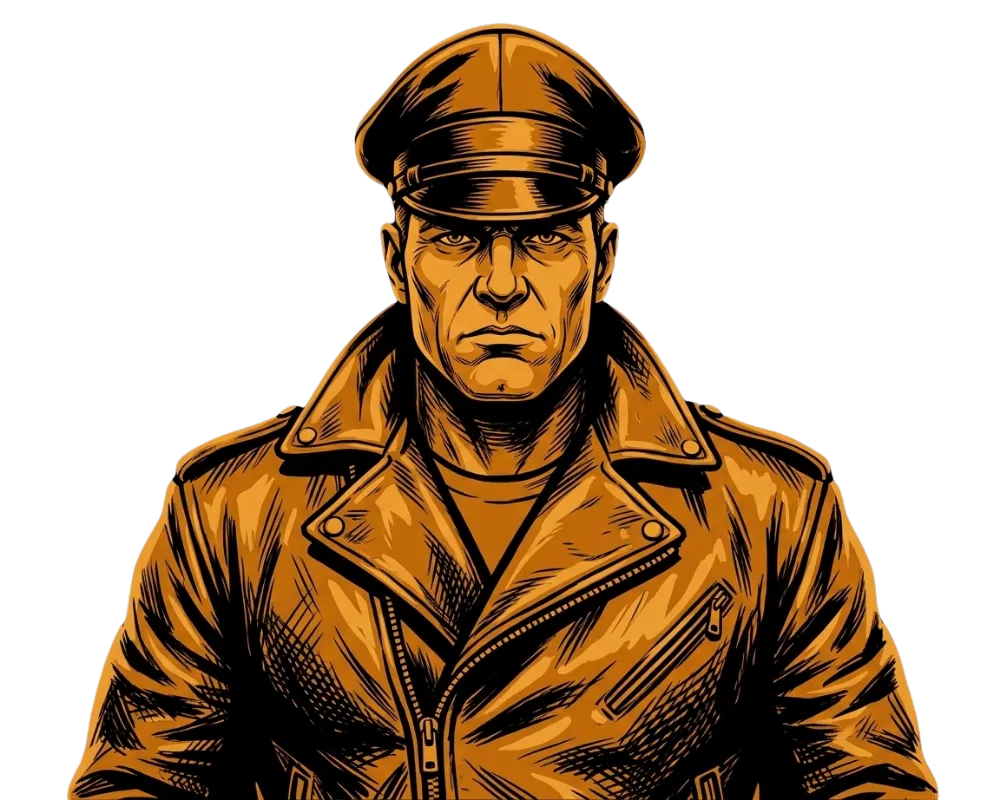
This article draws from online sources. It will be progressively enriched as community voices are shared.
What You Will Understand
- ▸Authority in leather comes from responsibility, not dominance or performance
- ▸A Sir carries the weight of another man's submission as a form of care
- ▸Leadership means mentoring, holding standards, and bearing the cost of that commitment
- ▸The Sir's role has shifted from pure tradition to intentional choice—and that matters
Table of Contents
1. The First Moment 2. What Authority Means 3. The Burden of Mentorship 4. Standards and Integrity 5. The New Guard Sir 6. Key Takeaways
The First Moment
The moment you say yes, something changes. A boy kneels. He puts his submission in your hands. Not because he has to—because he chooses to. And in that choice, you inherit responsibility. Not power. Responsibility.
A Sir is not a title you claim. It is a position you assume in relation to someone else. The boy's surrender gives you your authority. That authority is not a possession. It is a debt.
What Authority Means
In the Old Guard, a Sir derived authority from his knowledge, his consistency, and his adherence to protocol. He knew the tradition. He held the line. He was trustworthy because his word was his bond.
But there is a deeper thing beneath all of that: a Sir holds authority because he is willing to be responsible for the decisions he makes. When he says jump, he is responsible for where the boy lands. When he sets a rule, he owns the weight of that rule. When he demands service, he accepts the obligation to value it.
This is the inversion most dominant men never understand. You do not have power because you are strong or assertive. You have power because someone trusts you with something fragile. And that trust is conditional on your willingness to shoulder the cost.
A Sir holds authority not because he takes it, but because someone gives it to him—and he chooses to honor that gift with responsibility.
The Burden of Mentorship
Mentorship is not about showing a boy the ropes so he can leave you. It is about building him so that he becomes something he could not be alone.
A good Sir teaches not by lecturing but by example. He shows up. He is consistent. He corrects without humiliation. He demands excellence not to break the boy but to show him what he is capable of. He knows the boy's limits—both the hard ones and the soft ones—and he respects them without saying he is respecting them.
This takes time. It takes attention. It takes the willingness to be bored sometimes and to do the same thing again and again until it becomes internalized. It means the Sir must actually know leather, actually understand protocol, actually live the values he is transmitting. He cannot fake it. A boy feels inauthenticity immediately.
The burden is this: you become responsible for another man's understanding of himself. If you train him poorly, he carries that forward. If you train him well, he will spend years living out the values you gave him. That weight never leaves.
Standards and Integrity
One of the Old Guard principles was consistency. A Sir's word was law. But it was law precisely because it was predictable. The boy could trust it. The Sir did not change the rules based on mood. He did not make exceptions for himself. He held the line.
This is not about rigidity. It is about integrity. When you set a standard, you hold it for yourself first. You do not ask your boy to address you as Sir and then demand to be coddled. You do not set a protocol for his appearance and ignore your own. You do not expect obedience in the scene and disrespect in daily life.
The Sir who has integrity understands that his consistency is his authority. When he says something, the boy believes it because the Sir has proven through action that he means what he says. This is the opposite of fragile dominance, which uses punishment and manipulation to enforce compliance. The Sir with integrity does not need to remind anyone who is in charge. Everyone knows.
The New Guard Sir
The world has changed. The Sir of today often cannot mentor the way his predecessors did. There is no common ground of protocol everyone shares. The boy may come from anywhere, with any background, expecting anything.
But something essential remains: the Sir's job is still to build. To establish standards. To model integrity. To carry the responsibility of another man's submission.
Today's Sir works differently because he has to make explicit what the Old Guard could assume. He talks about values instead of simply embodying them. He negotiates protocols instead of imposing them. He builds relationships that are both founded on tradition and transparent about how they actually work.
This is not a weakening of the role. It is an evolution of it. The Sir who can hold authority while remaining flexible—who can honor tradition while respecting consent, who can demand excellence while explaining why—that Sir is doing the work of mentorship in a world that requires it.
The burden remains the same. The method changes to fit the world he actually lives in.
What does a Sir carry that others do not see?
From the Outside
“A Sir looks dominant. Controlled. Certain. He gives orders and they are obeyed. He seems effortless.”
From Inside the Role
“A Sir carries the knowledge that his every word shapes someone. He worries about getting it right. He knows his mistakes affect a boy who trusts him. He thinks about legacy. He is never entirely at ease.”
The Cost of Authority
The deepest truth about being a Sir is that it costs something. It costs time. It costs the ability to be purely selfish. It costs the freedom to act without consequence.
When you are with a boy who has given you his submission, you cannot simply do what you want in the moment. You must think. You must consider. You must ask yourself whether this action is one you are willing to own, that you can defend, that will build rather than damage.
You cannot take your anger out on him. You cannot use the dynamic to cover up your own insecurities. You cannot blame him when things go wrong. All of that is the cost. All of that is what it means to have authority that is real.
The Sir who understands this does not seek the role for the power. He seeks it because he is willing to carry the weight. Because mentoring another man matters to him. Because he wants to pass something forward that is real and whole and true.
That willingness—that is what makes him a Sir.
Transmission and Legacy
The Sir is not the end point of the line. He is part of a chain. Something was given to him—whether through formal mentorship, through absorption of leather culture, through the example of men he admired. Now he holds that and he passes it forward.
This is the hidden responsibility that most men never acknowledge. You do not mentor just for the boy in front of you. You mentor for the boys he will later mentor. You are building the future of the leather community. You are deciding whether these values survive or whether they die with you.
The Old Guard understood this implicitly. They were carrying forward something that was nearly destroyed—by AIDS, by persecution, by the loss of mentors and elders. Every boy they trained was an act of preservation. Every protocol they insisted on was an act of resistance against forgetting.
Today's Sir does not have quite the same pressure. But the responsibility is there. Transmission matters. What you pass on echoes.
Authority in leather is granted by the boy's submission—it is not taken; it is earned and then stewarded
A Sir's responsibility is the weight beneath all his power; he carries the consequences of his own decisions
Mentorship is the core work of a Sir—building another man through consistency, standards, and integrity
The new guard Sir adapts method while honoring values; he makes explicit what tradition allowed to remain implicit
The cost of being a Sir is the willingness to be responsible; the power is the privilege of shaping another man's understanding of himself
Tell Us About Your Sir
What quality or action in your Sir most demonstrates that he takes his responsibility seriously? What did he teach you about what leadership actually means in leather?
Contribute