This article draws from online sources. It will be progressively enriched as community voices are shared.
What You Will Understand
- ▸What a gimp actually is — and why it is not simply a sub in a rubber suit.
- ▸Where this comes from: the specific cultural lineage that produced the gimp archetype.
- ▸Why people want to be one — including the specific pull that has nothing to do with sex.
- ▸Why Doms want one — and what this dynamic offers that nothing else does.
Something Changes When the Hood Goes On
There is a moment — in a dungeon, at an event, walking into a room at a leather party — when you encounter one for the first time and something in you recognizes it before you have a name for it.
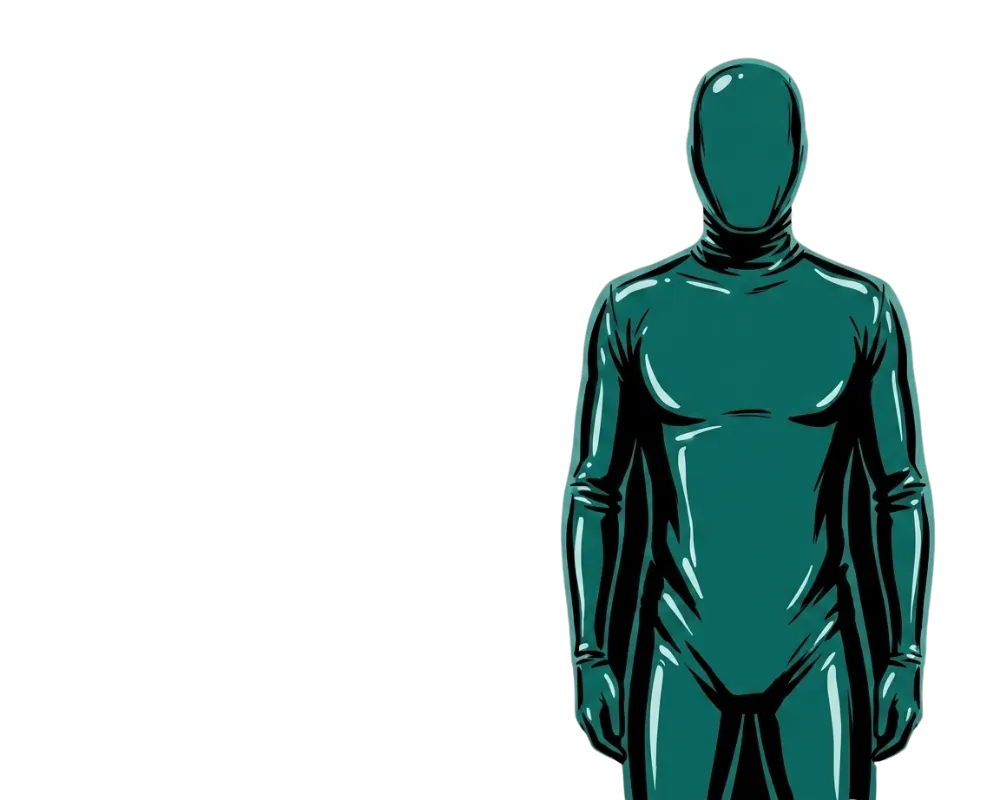
A body in a full rubber suit. No face. No expression. No hair, no skin, no feature you can read or respond to. The shape of a person without the content of one. Standing still, or kneeling, or positioned somewhere in the room with a quality of absolute availability that is unlike anything a person standing freely can produce.
What you are looking at is a gimp. And the reason something in you recognizes it before your brain catches up is that the gimp image operates below language — on the same register as the erotic, the uncanny, and the beautiful. It does not ask you to interpret it. It just lands.
Where It Comes From
The gimp did not appear with Pulp Fiction. Tarantino borrowed the image from a culture that had been building it for thirty years before his camera rolled.
The gay leather and rubber underground of 1960s and 1970s San Francisco, New York, and Chicago had already developed a precise vocabulary for total-enclosure submission. The Drummer magazine era. The back rooms of bars where dress codes were enforced with genuine seriousness. The early rubber scene in Germany and the UK. Men who had been making and wearing industrial rubber long before it had a name in mainstream culture.
What the community meant by the term was specific: not a sub, not a slave, not a bottom in the conventional sense. Something that had moved past all of those into a different category. An object. A thing. A body stripped of social identity by total physical enclosure, made available in a way no other state produces.
That specificity is still what the word means. Forty years later, in a world where the imagery is everywhere, the practice has not diluted. If anything it has deepened — because the people who do it seriously have had decades to understand what it is.
What It Actually Is
A gimp is not a sub who is wearing latex. The rubber is not decoration. It is the mechanism.
The transformation that defines the gimp state — the shift from person to object, from social presence to physical availability — cannot happen without full enclosure. The suit removes the skin that makes us readable. The hood removes the face that anchors identity. Without those two surfaces, a person becomes something the visual cortex cannot fully parse. It sees a human shape but finds no human there to respond to. That perceptual gap is where the gimp lives.
The suit and hood are not symbols of this transformation. They produce it. Take them off and it ends. Put them on and it begins. The gear is not the costume of the gimp. It is the gimp.
I am not a person wearing gear. I am the gear, ready for use.
— gimp_alex
Why Someone Wants to Be One
The pull toward the gimp role is not universal among subs and it is not casual. People who want to be gimps tend to know it with a particular certainty — a specific recognition that this and not something else is what they are looking for.
For many, the origin is not where you would expect. One practitioner traces it to a lifelong fascination with full-coverage figures in cinema — superheroes, Stormtroopers, sci-fi military gear. What resonated was not the costume but the transformation it implied: from individual to instrument, from a person with doubts and history and social anxiety to something with a singular purpose and no burden of self. The hood, when it finally arrived, completed that logic. The person who had always been anxious about being perceived disappeared. What remained was simply useful.
For others the pull is more immediate: the relief of not having to perform. Social anxiety, performance pressure, the exhausting project of being legible to others — the hood suspends all of it at once. No face to manage, no expression to control, no version of yourself to present. The suit takes all of that and holds it outside. What remains inside is simpler, warmer, more present to sensation and less present to everything else.
For some this is explicitly erotic. For others it is closer to relief — the feeling of setting something very heavy down. In most people who go deep into this role, the two are not separable.
The Service Gimp and the Erotic Gimp
Within the broader gimp identity there are two distinct expressions that are worth naming, because they attract different people and produce different scenes.
The erotic gimp is sexually available — used for pleasure, handled as an erotic object, penetrated or serviced as the Dom chooses. The objectification is specifically sexual. This is the most visible expression in the wider culture.
The service gimp is something else. Not primarily sexual — broadly functional. Cleaning. Cooking. Serving drinks. Acting as furniture: a table, a footrest, a cup holder, a urinal. The service gimp's fulfillment is in being used in every way possible, not in being used sexually. One practitioner describes it: *I do not seek to be used solely as a sexual object, but rather to be utilized in every way possible. I find far more fulfillment in being useful in a broader, more absolute sense.*
Most gimps move between these expressions depending on the Dom and the day. But understanding the distinction matters — a Dom who approaches every gimp as a sexual object will miss half the range of what is available, and may entirely miss what a particular gimp actually came for.
What a service gimp looks like in practice: one practitioner spent a birthday evening as the sole service gimp for a group of kinky guests — serving food and drinks, assisting with gear, maintaining the space, functioning as furniture on request. Many guests had never encountered a dedicated service gimp before. The interactions were entirely command-based — no social small talk, no casual greetings, even from people who recognized the person inside the suit. The gear communicated the status without a word needing to be spoken. *I am an object. Use me.*
The guests understood instinctively. That instinctive comprehension — the way a suited, hooded, available body communicates its own protocol — is one of the things that makes this practice work in social contexts.
Why a Dom Wants One
The Dom's pull toward a gimp is just as specific, and just as distinct from other power exchange dynamics.
The most consistent thing Doms report: there are no emotions to manage. A gimp in deep headspace does not have feelings that read on a face. He is not hurt by your tone, does not need reassurance, does not signal discomfort through expression or body language in the usual social way. You can be fully in your own experience — absorbed, focused, selfish with your attention — and nothing comes back as a demand. *I have a sensation of full power and dominance, and I don't have to deal with the sub's emotions, that they are not readable on its face.*
There is also the pleasure of composition — total control over an aesthetic object. Position him exactly as you want. No face pushing back, no personality asserting itself. The result is entirely yours. And there is the social dimension: displaying a gimp in company carries its own particular weight. *The gimp is like an accessory to my outfit, like a luxury watch to display.* People see a living being that has entrusted someone with its entire existence. That visible act of absolute ownership is itself a statement.
What Doms who are serious about this practice also report, and which surprises some people: gimp play is more demanding than most other sub dynamics, not less. Without facial expression and verbal communication, the Dom carries the entire perceptual responsibility for the scene. You must read the body, track the state, and make every decision alone. It requires you to be fully present and fully resourced. A Dom who plays with a gimp when tired, stressed, or distracted is not equipped for what the dynamic requires.
Who Gimps Are Today
The gimp community exists at the intersection of the leather world, the rubber world, and the wider BDSM scene — but it does not dissolve into any of them. It remains its own thing, with its own culture, its own gear, its own events and spaces.
You find gimps at Folsom, at Rubber Weekend in Munich, at MAL, at the Leather Pride events in Berlin and Amsterdam. In the leather bars of Montreal, Chicago, and London where the dress code is still enforced and the back rooms are still dark.
What the community shares is not a single aesthetic or a single practice. It is the recognition that the thing they want — the erasure, the transformation, the becoming-object — is not available anywhere else. No other kink produces it. No other gear replicates it. The suit is not optional and it is not a metaphor. It is the whole thing.
The gimp archetype has specific roots in gay leather and rubber underground culture — it predates pop culture representations by decades.
The suit is not the costume of the gimp. It is the mechanism that produces the gimp state.
People are drawn to the gimp role for multiple reasons: relief from social performance, the specific anonymity of being seen without being known, and the freedom of pure function.
The service gimp and the erotic gimp are distinct expressions — understanding which you are dealing with changes everything about the scene.
For Doms, gimp play is more demanding than most dynamics, not less — and offers something no other dynamic replicates.
What Drew You to the Gimp World?
The recognition moment is different for everyone. What was yours?
Contribute