This article draws from online sources. It will be progressively enriched as community voices are shared.
What You Will Understand
- ▸What gimp space actually feels like from the inside — the heat, the smell, the particular quality of disappearing.
- ▸What is happening neurologically that makes this state real, measurable, and distinct from other altered states.
- ▸How the descent happens — including what breaks it and how to recover when it breaks.
- ▸Why people actively seek this state, and what they find in it that they cannot find anywhere else.
Inside
The first thing is the heat. Rubber seals against the body immediately and body heat has nowhere to go. Within minutes the temperature inside the suit climbs to something that would be uncomfortable if it did not also feel like being held — evenly, from every direction, with no gaps.
The second thing is the smell. Latex has a specific scent — clean, chemical, something between industrial and organic. If you have worn latex before, that smell is already conditioned. Your nervous system has filed it under something specific. The moment you breathe it inside a closed hood, something begins to shift before anything else has happened.
The third thing is the sound. Inside a hood, your own breathing is amplified and close. The world outside goes quiet. What remains in the acoustic field is the rhythm of inhale and exhale, slightly changed by the material — slower now, because you are already beginning to slow. There is nothing to listen to except this.
And then the darkness. If the hood is blind, the visual field that the brain normally uses to triangulate position, threat, and social meaning disappears. The brain keeps trying to find something to orient to. It finds nothing. After a while, it stops trying.
This is how gimp space begins. Not with a decision. With a progressive reduction of everything the ordinary self runs on.
What Gimp Space Actually Is — Not Subspace
Gimp space is not subspace. The confusion is understandable — both involve altered states, both are produced by BDSM dynamics. But the cognitive territory is different.
Traditional subspace, as practitioners describe it, is active. The sub is still monitoring — tracking the Dom's reactions, performing devotion, seeking signals of approval, adjusting behavior in response. There is emotional engagement. There is still a self present, doing social work, even if that self is floaty and dissociated. That emotional engagement is itself a form of agency.
In gimp headspace, that layer is gone entirely. Planning, self-monitoring, social awareness — all of it vanishes. What remains is pure sensory processing and the execution of instructions. The capacity to form an independent thought or intention is genuinely offline. Not suppressed. Not quiet. Gone.
One practitioner describes it: *Gimp headspace is a complete cognitive void. There is no internal monologue, no anticipation, no micro-decisions about how to please. I can't take initiative. I wait to receive a clear instruction and I execute it — nothing more. It's a relief.*
That last phrase is the key. The absence of the monitoring layer is not experienced as loss. It is experienced as relief.
What Is Actually Happening
The state that experienced gimps describe has a precise neurological basis. It is not metaphor and it is not placebo.
The prefrontal cortex — the region responsible for decision-making, self-monitoring, social inference, and the continuous construction of the narrative self — requires input to run. Social cues, visual information, tactile data from the skin, the sense of voluntary agency over the body. Full enclosure systematically removes these inputs one by one. Without them, prefrontal activity progressively drops. Researchers studying flotation REST, deep meditation, and prolonged sensory reduction document the same process: the self-referential network quiets.
At the same time, deep even pressure across the entire body surface activates the parasympathetic nervous system. Cortisol drops. The same pathway documented in deep pressure therapy — applied to the whole body simultaneously, continuously, inescapably. The nervous system reads total compression as safety and responds accordingly.
Sustained physical stillness and immobility also activate the endorphin pathway — quietly, without the sharp edge of pain or effort. A slow warmth that builds over the duration of the scene.
Hypofrontality
Prefrontal quieting
The region governing selfhood, decision-making, and social identity loses input and reduces activity. Documented in flotation REST and deep meditation.
↓ Cortisol
Full-body compression
Deep Touch Pressure across the entire body surface activates parasympathetic response. The nervous system reads total enclosure as safety.
↑ Endorphins
Sustained stillness
The endorphin pathway activates under sustained immobility — quietly, without the edge of pain. Builds slowly over the duration of the scene.
Interoceptive shift
Sensory reduction
With external input removed, awareness turns inward: heartbeat, breath, temperature, pressure. The body becomes the entire world.
Pain Processing in Gimp Space
One of the less discussed aspects of gimp headspace is what happens to pain processing.
In ordinary waking consciousness, discomfort arrives with urgency. The signal is: something is wrong, act on it. The discomfort and the alarm are coupled.
In deep gimp space, this coupling loosens. Discomfort registers — the physical sensation is present — but the usual urgency signal does not follow. One practitioner describes it precisely: *discomfort registers, yet it lacks the usual sense of urgency.*
This has a significant practical implication. A gimp in deep headspace may not self-report a problem that in ordinary consciousness they would immediately communicate. Not because they are hiding it — but because the alarm that would normally drive communication is not firing. The Dom who is relying on the gimp to signal distress may not receive that signal when they need it. This is exactly why the Dom must read the body directly, continuously, without depending on verbal or behavioral self-reporting.
The Descent
Getting into gimp space is not a switch. It is a process that takes time — sometimes twenty minutes, sometimes an hour — and it passes through recognizable territory.
While the suit is going on, the person is still entirely present. Aware of the room, aware of the other person, running the usual social software. The hood is not yet on and the ordinary self is fully operational.
The moment the hood closes is different. Something shifts. Most people who have done this describe a specific interior sensation at that moment — a kind of click, or a drop, or a narrowing. The visual world ends. Social triangulation becomes impossible. The descent has begun.
For the next ten or twenty minutes the mind will try to compensate — generating internal chatter, surfacing anxieties, attempting to run its usual programs with no input to run them on. This is normal. It passes on its own. An experienced Dom does nothing at this stage except remain present.
Then the chatter runs out. The body, which has been warm and compressed and still this whole time, asserts itself more fully into awareness. Breath becomes the primary sensory event. Time becomes approximate. What remains is simpler. This is gimp space.
One practical detail about the deep state: the gimp who has received an instruction and executed it will continue executing it until a new instruction arrives. Without a mechanism to interrupt the loop, they will repeat the last task indefinitely — sometimes in ways that are logistically absurd, but always with complete commitment. This is not malfunction. It is the deep state functioning exactly as it should. The Dom who understands this plans instructions accordingly.
What It Is Like to Be There
People who reach deep gimp space consistently describe it in terms that surprise those who have not been there: profoundly calm. Not exciting, not frightening — calm in a way that is also, paradoxically, intensely present.
The heat has become a constant — no longer something you notice, just the condition. The smell of rubber has saturated the available air. The breath goes in and out with a rhythm that has been going for a while and will keep going. There are no decisions to make. There is nothing to figure out. There is nothing to be except this.
What is absent is more striking than what is present. The usual anxiety that runs under everything in waking life — the monitoring, the self-evaluation, the social awareness, the anticipation — is gone. Not suppressed. Actually gone, because the inputs that generate it have been removed.
And then, beneath everything: the awareness that someone is there. Not a thought — more like a felt fact. The darkness is held. Someone is on the other side of all this rubber. That relational thread, even at its thinnest, is the difference between this and isolation. It is what transforms constraint into something you can inhabit rather than merely endure.
Touch, in this state, carries a specific weight. Physical contact through the material is deeply valued — craved, even. It functions as silent validation, an acknowledgment of utility. But what resonates is not skin contact — it is contact with the object-shell. The rubber is the medium. Touch through rubber reaches the gimp differently than touch on bare skin. This is not incidental. It is structural to the state.
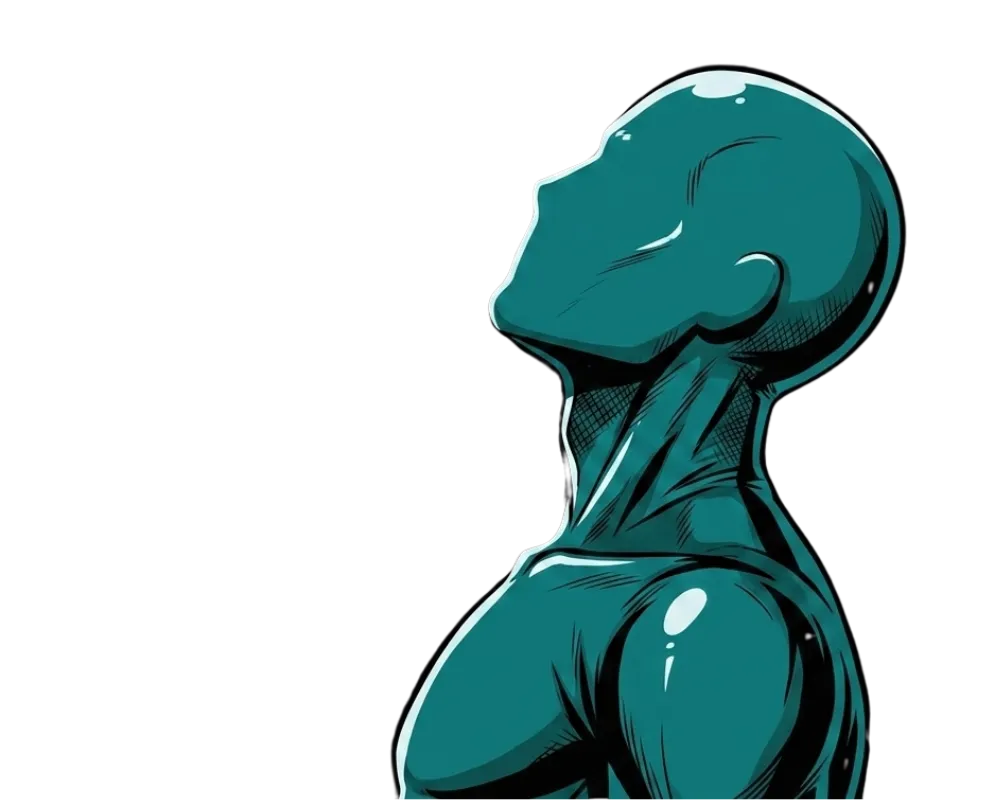
It is not like going somewhere else. It is like everything else going away and discovering that what is left is enough.
Why People Want This
Ego dissolution — the temporary quieting of the self-referential processes that constitute ordinary identity — is something that cultures across history have sought through every available means. Meditation. Ritual. Psychedelics. Extreme physical effort. The consistency of the seeking across such different methods suggests that the capacity itself is fundamental, and that accessing it produces something people genuinely need.
Gimp space is ego dissolution through somatic means. The body is the vehicle. The suit achieves in forty minutes what certain meditation traditions require decades to approach.
For people who find their way to this practice, what they are often describing is not a kink in the conventional sense. It is closer to a practice — something they return to because what they find there is not available anywhere else. People who do this regularly tend to carry something back. A quality of calm. A loosened grip on the machinery of self. The effect lasts beyond the scene.
Coming Back
The return does not happen when the hood comes off. It happens gradually, over fifteen to forty-five minutes — sometimes longer after a deep or extended session. What emerges from the suit is between states. Not yet the person, not quite still the gimp. Slow, heavy, open in ways that will close again soon.
This transition needs specific handling. Keep physical contact through the desuiting. The skin after rubber is hypersensitive — bare air can feel almost abrasive. Cover it. Provide warmth. Do not ask questions, do not reach for a debrief, do not treat this person as fully returned before they are.
One technique that practitioners have found effective for preserving the transition: when the hood must come off, covering the eyes immediately with a hand or a secondary blindfold. Reintroducing visual input is the most disruptive part of the exit. Delaying it gives the nervous system time to adjust gradually rather than cutting abruptly from darkness to full social reality.
In group or public settings, moving the gimp to a private space for the transition is also important — not from shame, but because encountering other people's social gaze during the return can shatter the remaining headspace before it has fully resolved.
The return announces itself in the breath, which quickens slightly. In the eyes, which refocus. In a quality of presence that was not there five minutes ago. When it arrives, conversation becomes possible. Until then, presence is the only care that fits what just happened.
Gimp space is not subspace — it is a complete cognitive void. The emotional agency layer that subspace retains is fully gone.
Pain processing changes in deep gimp space: discomfort registers but loses its urgency signal. The Dom cannot rely on self-reporting.
The descent takes time and passes through resistance. The mantra of repeating the last instruction keeps the gimp anchored when the loop threatens to break.
Touch through the object-shell is experienced differently from skin contact — the rubber is the medium, not an obstacle.
The exit is gradual. A secondary blindfold and movement to a private space help preserve the transition.
What Does Gimp Space Feel Like For You?
Every account is different. Yours might be exactly what someone else needs to read.
Contribute