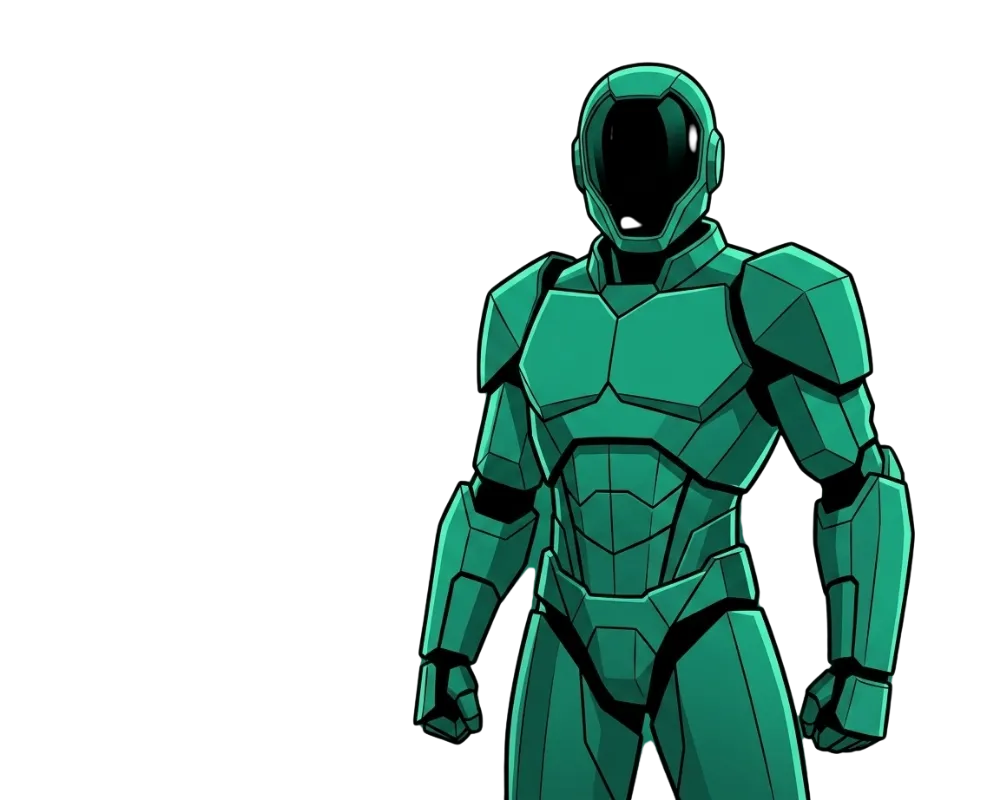
This article draws from online sources. It will be progressively enriched as community voices are shared.
What You Will Understand
- ▸What drone space actually feels like — from inside the latex, behind the gas mask, running idle processes.
- ▸Why each piece of gear contributes a specific element to the psychological state.
- ▸The neuroscience: what ego dissolution, decision fatigue relief, and sensory redefinition actually produce in the brain.
- ▸How drone space is reached, maintained, and exited — and what each phase requires.
Inside the Suit
The catsuit is on. It took effort — latex fights back, requires lubrication, requires careful alignment of seams before it will sit right. By the time it is on, the body is already aware that something different is happening. The material is omnipresent, squeezing consistently from ankle to neck, trapping heat, not breathing. Every movement is slightly harder than it should be. Every sensation passes through a membrane.
Then the hood. The gas mask's rubber seam settles against the face and an airtight seal forms. The 10,000 variations of facial expression that the human face is capable of — all of them dropped, unneeded, beneath the blank visor. The brain's facial processing systems go quiet: no face to display, no face to read. Something releases.
The headphones slip on. Binaural beats begin. The outside world becomes muffled, restructured, less relevant. The smell is rubber. The sound is the hiss of the valve and the slow rhythm of controlled breathing. The visual field is narrowed and tinted. All five senses have been redefined by the gear.
This is not the beginning of drone space. It is the conditions being established in which drone space becomes possible. The state itself arrives gradually, as the brain adjusts to the new sensory environment and the programs that normally run the social self run out of input to run on.
What the Gear Actually Does — Piece by Piece
Every piece of drone gear is doing specific psychological work. Understanding what each one contributes makes the dressing process itself a precision instrument rather than a ritual.
The Dronification Stack — What Each Layer Removes
**The catsuit** — Removes the body as an individual surface. Skin, contour, color, texture — all of it replaced by uniform black latex. The body becomes a shape. The shape is the same as every other drone's shape. Individuality at the physical level is gone. **The corset** — Amplifies the compression, adds a layer of physical control that is felt with every breath. The body is further contained. Its silhouette is defined not by its own biology but by the gear's engineering. **The gloves** — Remove fine motor agency. You cannot manage a zipper, open a door, or gesture expressively. Simple physical tasks require deliberate focus. Useless hands drop to the sides. The drone waits. **The hood** — Removes the face. With it goes every social signal the face carries. Expressions, micro-expressions, the readable personality that a human face broadcasts continuously. The tinted visor is blank. Everyone looking at it sees the same thing: a drone. **The gas mask** — Restructures breathing into a mechanical, audible process. Filters and mediates the air itself. Removes the last connection between the drone's face and the environment. The hiss of the valve is the whole soundscape. **The headphones** — Replace external acoustic input with controlled audio. Binaural beats, mantras, protocol recordings. The last channel through which the outside world enters has been claimed by the operator.
The Neuroscience of Nobody
The drone state produces measurable changes in how the brain processes information. They are not unique to dronification — the same changes are documented in meditation, psychedelic ego dissolution research, and studies of flow states — but dronification achieves them through somatic and environmental engineering rather than chemistry or years of contemplative practice.
The default mode network — the brain's self-referential system, the neural infrastructure of the sense of self — requires input to operate: social cues, environmental context, the continuous stream of decisions and evaluations that fill waking consciousness. Drone gear removes most of that input systematically. The visual field is dimmed and narrowed. Tactile sensation is homogenized to rubber. Facial processing has nothing to process. Acoustic input has been replaced by controlled audio. The default mode network is running on fumes.
At the same time, decision fatigue relief activates. The research on decision fatigue is well-established: the quality of executive decisions degrades as the day's cognitive budget depletes. For people who make many decisions daily, the feeling of exhaustion is partly the fatigue of having a continuously active prefrontal cortex. Drone space does not just reduce the number of decisions — it removes the decision-making apparatus from operation entirely. The task queue is managed by the operator. The drone executes. The specific quality of rest this produces is not relaxation. It is operational suspension.
Input-starved → quiets
Default mode network
The self-referential neural network requires social, environmental, and decision input. Drone gear removes all three systematically. DMN activity drops.
Suspended
Facial processing
The brain dedicates significant resources to producing and reading facial expressions. Behind a gas mask, both functions become unnecessary. That load lifts.
Operational suspension
Decision fatigue
Prefrontal executive function is depleted by continuous decision-making. Drone space removes decision-making entirely — not reducing it but suspending the apparatus.
All channels claimed
Sensory redefinition
Each sensory channel has been claimed by the gear: touch is latex, smell is rubber, hearing is controlled audio, vision is filtered. The brain cannot interface with ordinary reality.
Idle Processes
A drone with no assigned task stands to attention. Its posture is precise. Its breathing is slow and controlled. Its mind is either completely empty or cycling through its conditioning mantras. It is aware of its environment only insofar as its muffled sensory inputs allow — analyzing sounds for authorized user signals, discarding the rest.
This state — running idle processes — is one of the most distinctive elements of drone space. It is not the energized attentiveness of a pup in play, or the deep still warmth of a gimp in enclosure. It is something more mechanical: a readiness that has the quality of a device on standby. Present, functional, empty of content, awaiting input.
For the drone, idle processes feel like the opposite of the mental noise of ordinary waking life. No problem-solving, no anticipation, no social evaluation. The mind that normally runs dozens of concurrent processes is running one: wait. This is experienced as quietness with a specific texture — not peaceful in an emotional sense, but quiet in an operational one. The machine is not broken. It is waiting.
A drone lives so perfectly in the moment. It has no past, for memories have been superseded by its programming. It does not contemplate the future. It has only its presently assigned task.
— HexCorp, The Case for Dronification
The Descent — Getting There
Drone space does not arrive when the last piece of gear goes on. It arrives as the brain processes its new conditions and adjusts its operating mode.
The dressing process accelerates this adjustment. Each item — catsuit, hood, gas mask, headphones — adds a new layer of sensory and physical change that the brain must process. By the time the last piece is in place, the nervous system has been receiving transition signals for fifteen to thirty minutes. The adjustment has begun well before the first command arrives.
The first several minutes after the dressing is complete tend to be the most cognitively active. The human self is still running its programs, attempting to orient, evaluating the situation. This is normal and passes. The experienced drone lets it pass. The operator, if present, gives the system time to process rather than immediately issuing commands.
Then the programs run out of input. The social self has been trying to triangulate its environment — who is here, what is expected, how should I be — and is receiving nothing useful. It cannot read the gas mask's expression. It cannot locate the other drones as individuals. The operator's language follows protocols that bypass social processing. There is nothing to work with. The social operating mode suspends.
What remains is the drone.
Exit and Reintegration
Coming out of drone space is the reversal of the dressing process, but the psychological transition is not immediate. The drone state, once established, does not dissolve when the gas mask comes off. There is a period — variable in length, longer after deeper or longer sessions — during which the person is between states.
Operators and the person coming out of drone space should both know what this looks like: slow verbal processing, disorientation in unstructured social situations, a quality of blankness that is not distress but is also not ordinary social readiness. The person is not fully back yet.
The managed transition helps: removing gear in reverse order and at a deliberate pace, maintaining physical closeness and contact, not immediately demanding social interaction or emotional processing. Some people want specific aftercare — food, warmth, physical contact. Others need time before they are ready for conversation.
The depth of drone space is partly what makes the aftercare non-trivial. The state was not a surface performance. The brain was operating in a genuinely different mode. The return to ordinary mode takes time.
Each piece of drone gear is doing specific psychological work — the dressing process is the precision engineering of the drone state's conditions.
The default mode network quiets when its inputs are systematically removed. Drone space is the operational suspension that results.
Idle processes — the standby state between commands — feel like operational quiet, not emotional peace.
The descent takes time. The social self keeps running its programs until it runs out of input. Experienced drones let this pass without forcing it.
The exit is gradual. The brain was in a different operating mode; the return to ordinary mode takes as long as it takes.
What Does Drone Space Feel Like For You?
The inner experience of the drone is rarely described well. Tell us what it actually is.
Contribute